

Photo Credit: shutterstock.com/Sundry Photography
California Forward (CA FWD) and Resilient Cities Catalyst (RCC) are turning Climate Resilience Districts (CRD) from statute into practice through the Resilience District Incubator (Incubator) project. The Incubator is designed as a learning pathway for local and regional governments exploring how CRDs, and related governance, funding, and financing tools, can help advance long-term climate resilience. Through close collaboration with pilot communities, CA FWD and RCC will support communities in assessing whether a resilience district is the right fit for their needs, while also identifying alternative pathways where other models may be more appropriate.
By Alexis M. Pelosi
In this recent blog post, we described the difference between California’s two climate financing districts – the Climate Resilience District (CRD) and the newer Disaster Recovery District (DRD). Here, we turn to the difference between a CRD and an Enhanced Infrastructure Financing District (EIFD), the statutory framework on which CRDs are built.
A common misperception is that CRDs are simply an EIFD with a climate label attached. But the Legislature did far more than authorize EIFDs to fund climate projects. It added governance, planning, and financing tools that equip CRDs to fulfill their central mission: coordinating, funding, and sustaining climate risk reduction over time.
What is an EIFD – the TIF baseline
An EIFD is a tax increment financing (TIF) tool. Local government identifies an area, draws a boundary around it (i.e., the district), establishes baseline property tax values for the district, and then captures the growth in property tax revenue above that established baseline over time. This growth in property tax revenue is the “increment” used to pay for infrastructure improvements within the district.
The EIFD can spend the increment as it is collected or borrow against anticipated increment, either by issuing tax increment bonds or obtaining loans, to finance eligible infrastructure and other capital projects. It does not impose a new tax or fee.
That’s it, that’s the core revenue tool of an EIFD. While that’s the primary tool, two other potential revenue streams do exist – funding from revenue generated by the infrastructure projects financed and local share of sales and use taxes (SUT) and transaction and use taxes (TUTs) – but require local government approval and are much less commonly used. An EIFD does not have independent authority to levy special taxes or property-related fees, issue general obligation bonds or revenue bonds, or fund the ongoing operations and maintenance (53398.52(a)(3)) of the projects they build. Put simply, an EIFD can help build and maintain infrastructure. It is not structured to staff and perform long-term operations and maintenance.
What SB 852 Added – in the Legislature’s own words
The legislative history for SB 852, which created CRDs in 2022, is robust, showing the serious debate that occurred around the intent and purpose of CRDs. The goal of the bill, according to its author was to give communities “the means of establishing local entities which span jurisdictional boundaries and focus resources on the most urgent aspects of climate change as determined locally,” and allow local government to “channel local, state, federal, and private funds in a coordinated manner within a jurisdiction or across jurisdictional lines to have the greatest impact possible.” (Author’s Statement, Assembly Local Government Committee, 6/14/22).
To meet this goal, the Legislature had to reckon with the limitations of EIFDs, but in the end, the Legislature decided to give CRDs “[e]every tool in the toolbox.” (Senate Floor Analysis, 8/15/2022).
Here is what a CRD can do that an EIFD cannot:
- Levy a special tax (62307(a)). A CRD can place a special tax on the ballot in its own name. Subject to two-thirds revenue approval (Cal. Const. Art. XIII C), this revenue can fund operations. TIF revenue bonds cannot fund this kind of ongoing work, and tax increment has strict limitations.
- Levy a benefit assessment (62307(a)). A CRD can assess a targeted charge on properties that receive a direct benefit from a district project. Funding is tied to demonstrated value and is not dependent on new development.
- Charge property-related fees (62307(a)). A CRD can charge fees tied to the cost of what a specific service the district provides. Tied directly to the actual cost of providing the service, it spread across properties that use or benefit from it. Fees are not a tax and cannot exceed the cost to provide the service.
- Issue non-TIF revenue bonds and general obligation bonds (62307(d)-(e)). A CRD can issue bonds in its own name, with general obligation bonds requiring two-thirds voter approval. (Cal. Const. Art. XIII A). The borrowing power of bonds allows larger, longer-term capital investments. Revenue bonds are repaid from specified district revenues, while general obligation bonds are backed by voter-approved property taxes.
- Receive a dedicated revenue source (62307(f)). A CRD can receive directed revenue carved out from a portion of a participating city or county’s revenue. This redirects existing revenue; it does not generate new revenue.
- Enter into joint powers agreements (62307(k)). A CRD can partner with a flood control district, a water agency, or another special district or public agency to deliver a project – pairing a CRD’s funding capacity with operational expertise without giving up either side’s governance or revenue streams. This goes beyond funding to effective project delivery.
Perhaps the most important addition granted by the Legislature to CRDs is the ability to fund ongoing operations and maintenance. CRDs can hire staff, fund project planning and operational costs, and cover the expenses of running the district, including using interim or temporary staff provided by member agencies. This broader authority fits the nature of climate-risk reduction, which often requires the continued operation of completed projects or recurring interventions such as prescribed burning and vegetation management.
An EIFD is built to finance infrastructure (53398.52(a)(3)). A CRD builds on that foundation by both financing projects, keeping them running, and drawing on a broader set of revenue tools. And, while some of these tools require voter or property owner approval, they remain part of a CRD’s statutory toolkit, not an EIFD’s.
Expansion Isn’t Unlimited
A CRD’s authority to finance, plan, and implement projects and programs is broad, but it is not unlimited. The Legislature recognized it was granting CRDs expanded authority and tools and put boundaries around some of them.
For example, CRDs have broad general special tax authority, but that doesn’t mean they can ignore the statutory requirements for adopting a particular tax. Any CRD seeking to use a sales or use tax must still comply with the specific requirements to adopt that type of a tax (i.e., purpose requirements, boundary limitations, and allocation processes). If the constitution requires a tax to obtain two-thirds voter approval, a CRD must clear that hurdle before levying the tax. So, while CRDs have broad tax authority, that authority is limited by the underlying tax adoption framework.
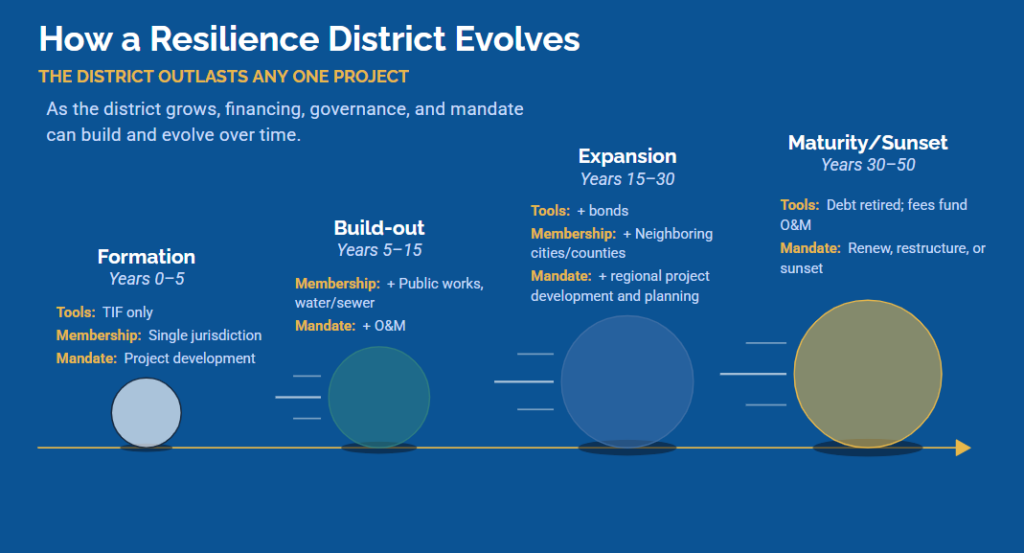
This combination of broad authority and tool-specific guardrails makes a CRD a platform designed to grow alongside a community’s needs rather than a one-time financing choice. An early-stage CRD may look a lot like an EIFD in practice, building capacity and projects, but a mature CRD may look completely different – layering assessment, fees, special taxes, and bonds into a diversified, durable funding structure.
Conclusion
A CRD is not an EIFD with a climate label. It reaches beyond tax increment financing (TIF), offering a larger, more flexible toolkit purpose-built for the reality that climate resilience work does not stop at construction.
As we noted in this blog post, the right tool at the right time matters. The Legislature built CRDs to meet communities’ needs today and allow them to grow over time. In the posts ahead, we will take a closer look at how communities can identify where a CRD makes sense and how the geography of climate risk and project benefits can shape district boundaries.