


REGIONS-UP
Regions matter — and California needs a better system to support them. For nearly 20 years, CA FWD and the California Stewardship Network (CSN) have championed the idea that regional voices must be heard in Sacramento. Today, as the state faces economic, climate, and equity challenges, it’s time to go further: to build a durable system for regional implementation, funding, and collaboration.

Why Regions Matter

  • California’s size and diversity mean its regions have distinct histories, economies, and needs.
  • Most day-to-day issues — from job access to climate impacts — are shaped regionally.
  • Yet despite their differences, California’s regions are deeply interconnected through supply chains, labor markets, and resource flows.

A regions-up approach recognizes these differences while strengthening connections across the state.

Five Challenges Facing Regional Policy Today

  1. Sunsetting Programs: California Jobs First is scheduled to end in 2026. Without a replacement, momentum could stall.
  2. Outdated Planning Laws: SB 375 is under strain. Housing, transit, and climate goals are not being met.
  3. Climate Risks without Regional Resilience: Climate resilience isn’t integrated into regional plans.
  4. Shifting Federal Investment: A potential decline in federal funding raises the stakes for state action.
  5. Looming Leadership Transitions: A new Governor and Legislature could disrupt current regional progress.

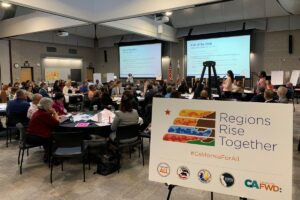
Regions Rising Together: California’s Recent Efforts to Translate Regions Up Vision Into Regional Investment

This white paper traces the origins of California’s regions-up experiment, from the early days of the Newsom Administration’s Regions Rise Together vision through the investments that followed. While the model proved viable, key challenges around institutional durability, cross-program alignment, and uneven regional capacity remain.

READ THE WHITE PAPER

CA FWD’s Vision for State and Regional Economic Partnership: Summary of Current Recommendations

Learn more about our Regions-Up Workgroup, which is developing a policy playbook and building a statewide coalition to advocate for and implement a durable regions-up economic model.

READ MORE

White Paper: Learning from Our Peers: Lessons and Case Studies On Regional Economic Development from Various US States

Read this white paper to understand what California can learn from other states as we build a more durable regions-up system.

READ THE WHITE PAPER

Report: Building a Durable System for Inclusive, Sustainable Regional Economies

Read this report to learn more about how CA FWD and the California Stewardship Network are shaping the future of regional governance in California.

READ THE REPORT

Read the Latest CA FWD Regions-Up News on the Blog

A Key Step Toward Institutionalizing Regions-Up: California’s proposed Office of Regional Economic Development Initiatives
1024 703 CA FWD

CA FWD supports the the Governor and Legislature for establishing the “Office of Regional Economic Development Initiatives” (REDI) within the Governor’s Office of Business and Economic Development (GO-Biz).
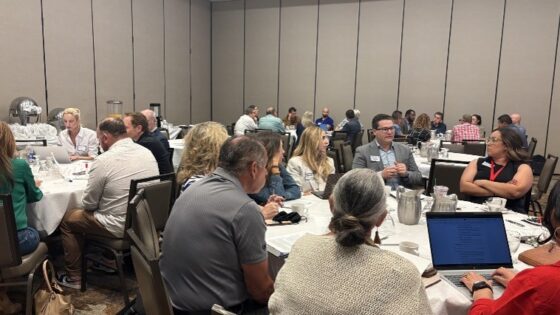
Fresno Regions Up Convening May 2026
What We Heard Across California: Takeaways from the Regions Up Convenings
758 568 CA FWD

This past year, CA FWD facilitated discussions with partners across the state to develop key policy recommendations for the new governor and legislature aimed at creating a more resilient, regions-up economic model in California.

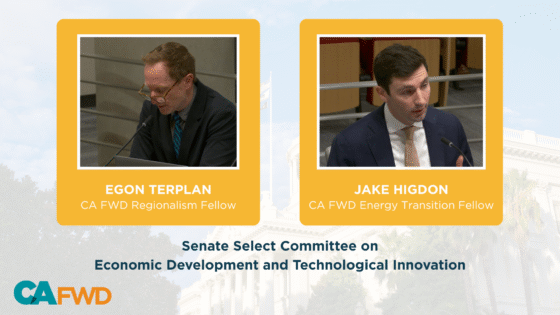
CA FWD’s Testimony at the Senate Select Committee on Economic Development and Technological Innovation
1024 576 CA FWD

CA FWD’s Regionalism and Energy Transition Fellows testified at the Senate Select Committee on Economic Development and Technological Innovation hearing, providing testimony on California’s economic development system and regional industrial strategy.

Building a More Durable Regions-Up System: What California Can Learn from Other States
1024 683 CA FWD

California needs a system that endures beyond any one administration—a “regions-up” model where state policy, funding, and regional priorities are fully aligned.