
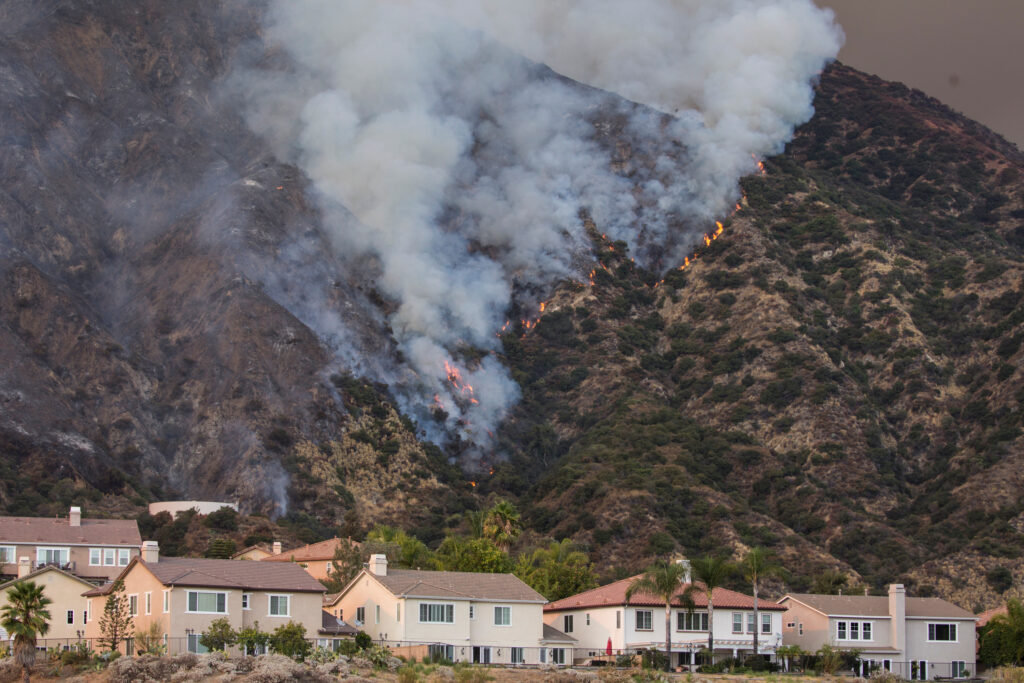
Photo Credit: Shutterstock.com/Ringo Chiu
California Forward (CA FWD) and Resilient Cities Catalyst (RCC) are turning Climate Resilience Districts (CRD) from statute into practice through the Resilience District Incubator (Incubator) project. The Incubator is designed as a learning pathway for local and regional governments exploring how CRDs, and related governance, funding, and financing tools, can help advance long-term climate resilience. Through close collaboration with pilot communities, CA FWD and RCC will support communities in assessing whether a resilience district is the right fit for their needs, while also identifying alternative pathways where other models may be more appropriate.
In California, we are no strangers to climate risk. From wildfires and flooding to sea level rise, extreme heat, major winter storms, and drought — California has experienced them all.
Communities are being asked to do several hard things at once: plan ahead, invest in risk-reduction, and harden infrastructure before disasters occur; and recover faster, more cost-effectively, and with an eye toward reducing future risk when they do — all while continuing to deliver the day-to-day public services residents rely on.
One of the biggest barriers is not a lack of good ideas and local champions. It is the lack of durable, locally controlled funding and financing mechanisms to move critical projects from planning into implementation, operations, maintenance, and long-term recovery.
To help address this challenge, California has created two powerful financing mechanisms — the Climate Resilience District (CRD) and the Disaster Recovery Financing District (DRD). This article explains each tool, how they are like and how they differ, and why understanding the difference matters.
A Common Foundation
CRDs and DRDs are special financing districts built on the same legal framework — the Enhanced Infrastructure Financing District (EIFD).
Both tools are governed by a Public Financing Authority (PFA), a board made up of representatives from participating local governments and members of the public, giving communities direct oversight of how district revenue is raised and spent. They both draw from the same broad financing toolbox, including tax increment financing, benefit assessments, special taxes, grants, and bonds.
While their foundation and tools are the same, their purpose, timing, and scope are very different. A CRD is designed for long-term climate resilience planning, investment, and maintenance. A DRD is designed for the urgent period after a disaster, when communities need to organize recovery financing quickly and make rebuilding decisions that reduce future risk.
Separate Tools for Separate Moments
The following questions highlight the key differences between CRDs and DRDs.
When can each be used and for how long?
A CRD can be formed at any time. A DRD can only be formed after the Governor has declared a state of emergency, and only within two years of that declaration.
Trigger:
- CRD: Local government decision – no external event required
- DRD: Governor-declared state of emergency
Window to form:
- CRD: Anytime
- DRD: Within two years of the emergency declaration
Time horizon:
- CRD: Long-term, ongoing; designed to operate as long as climate resilience needs exist
- DRD: Purpose-limited; designed to wind down with the recovery
How fast can one be stood up?
CRDs and DRDs follow a similar multi-step formation process, but they are designed for different circumstances: a CRD is a very deliberative process appropriate for long-term governance and financing approaches, whereas a DRD process is designed to move quickly to capture the narrow window between the disaster and the start of rebuilding.
Formation timelines:
- CRD: Often 1-2 years
- DRD: Expedited – designed to move within months of a disaster
Key Steps:
- CRD: Resolution of intention and if tax increment is pursued, an infrastructure financing plan which requires multiple public hearings.
- DRD: Same core steps as CRD, if tax increment is pursued, infrastructure financing plan is compressed into two public meetings with streamlined notice requirements.
What can the money actually pay for?
Both CRDs and DRDs have access to the same broad toolbox of financing mechanisms — tax increment financing, benefit assessments, special taxes, fees, grants, gifts, and bonds. The difference is not what tools are available, but rather what the money can be spent on.
What the money can fund
- CRD: Capital projects and ongoing operations and maintenance for projects and activities addressing climate hazards; CRDs can hire staff
- DRD: Three purposes only: repair/replace disaster-damaged property; mitigate future disaster risk; support economic recovery. Mitigation actions must be to the declared disaster and geographically constrained to district boundaries
Bond proceeds
- CRD: Cannot fund operations, programs, or services
- DRD: Cannot fund operations, programs, or services
Are there real-world examples?
California is in the early stages of putting these new tools to use. CRD’s were established in 2022. DRD’s were enacted in 2025 (SB 782), partly in response to the January 2025 wildfires in Los Angeles.
Example
- CRD: Sonoma County Regional Climate Protection Authority (RCPA) – designated as California’s first CRD under SB 852 (2022) but not yet leveraging financing strategies; City of Inglewood formed the Inglewood Climate Resilience District (ICRD) in late 2024 for the Inglewood Transit Connector (ITC) and is currently in the process of drafting its IFP.
- DRD: Altadena Wildfire Recovery Infrastructure Financing District and Unincorporated Santa Monica Mountains Wildfire Disaster Recovery Financing District. Both were enacted by Los Angeles County within 40 days of SB 782 being signed into law.
These early examples show both the promise and the challenge of the tools. CRDs create a pathway for investment, but communities are still learning how to use the financing authorities available to them. DRDs can be formed quickly in response to disaster, but they require communities to act during an already difficult recovery period whereas CRDs require local leaders to act with urgency around risks that may feel less immediate, even when the costs of inaction are high.
Before and After: Why Both Tools Matter
Both CRDs and DRDs put local governments, residents, and businesses in the driver’s seat of their resilience and recovery efforts. Whether acting before a disaster or rebuilding after one, both tools give communities the financial agency to shape their own future rather than waiting on outside help.
A CRD lets a community get ahead of climate risk on its own terms — determining priorities for action and building dedicated funding and investing in resilience before disaster strikes. CRDs are a long-term governance commitment, designed to grow and adapt alongside a community’s needs and risk profile.
A DRD takes that same principle and applies it in the aftermath of a disaster. It lets the community lead its rebuilding and recovery efforts by directing dedicated local revenue toward repairs and recovery programs. For DRDs, however, speed is critical. As the most prominent tool in its toolbox is tax increment financing, communities are in a race against time to stand up the DRD before reconstruction drives property values back up. And, even when that race is won, the district’s revenue takes time to build.
Despite their shared framework, a DRD is not a substitute for a CRD. A CRD can fund a far wider range of work, including ongoing operations of projects and activities addressing a community’s climate risk, than a DRD which is narrowly locked to three disaster-recovery purposes.
**NOTE: The gap between the urgency of recovery and the pace of tax increment revenue is a real and current challenge, as forming a DRD does not create immediate cash. Tax increment financing, often highlighted as the district’s most significant tool in a post-disaster context, builds over time as property values recover and grow. This means communities may still need to access upfront funding sources to bridge early recovery needs, even after a district is in place.
Conclusion
California is in the early stages of putting CRDs and DRDs to work, and the stakes and importance of succeeding are high. CRDs address the long game — building resilience before disaster strikes. DRDs address the immediate aftermath — speeding recovery when disaster has already occurred. One model does not replace the need for the other.
California needs both. And it needs to start using them.
In the posts ahead, we will take a deeper look at how CRDs work, what it takes to stand one up, and how communities across the state can put them to use.