
By Taylor Carnevale & Nuin-Tara Key
The Community Wildfire Resilience Workgroup, convened in partnership with Resources Legacy Fund, brings together leaders across wildfire science, land use, insurance, finance, and community implementation to advance a coordinated, long-term approach to reducing California’s growing wildfire risk to homes, infrastructure, and other parts of the built environment — and to addressing the impacts on our economy, insurance markets, and public budgets.
California faces a difficult wildfire resilience question: how do we make smarter decisions about reducing risk when the stakes are high, public resources are limited, and responsibility for action is spread across our entire economy, requiring action from households, local businesses, communities, insurers, utilities, and government?
Wildfire “risk” and “hazard” are often used interchangeably, but they mean different things. Wildfire hazard refers to the likelihood that a fire will start and the potential intensity and spread in a given location. Risk is broader; it combines that hazard with the potential consequences for communities, infrastructure, the economy, and natural systems. For that reason, no single map or score can answer every question about wildfire risk. A community planning evacuation routes needs information about likely fire behavior and road access. A state agency directing mitigation funding also needs to know where vulnerability and potential losses are greatest. Those are different decisions, and they require different information.
At the same time, decision makers have access to better data and more advanced tools. These include “mitigation standards” that identify steps that can be taken to reduce wildfire damage, as well as catastrophe and conflagration models that estimate potential losses and how fire could spread through a community, including from structure to structure. This information can help guide investment, identify which actions are likely to have the greatest effect in each place, and strengthen incentives to act.
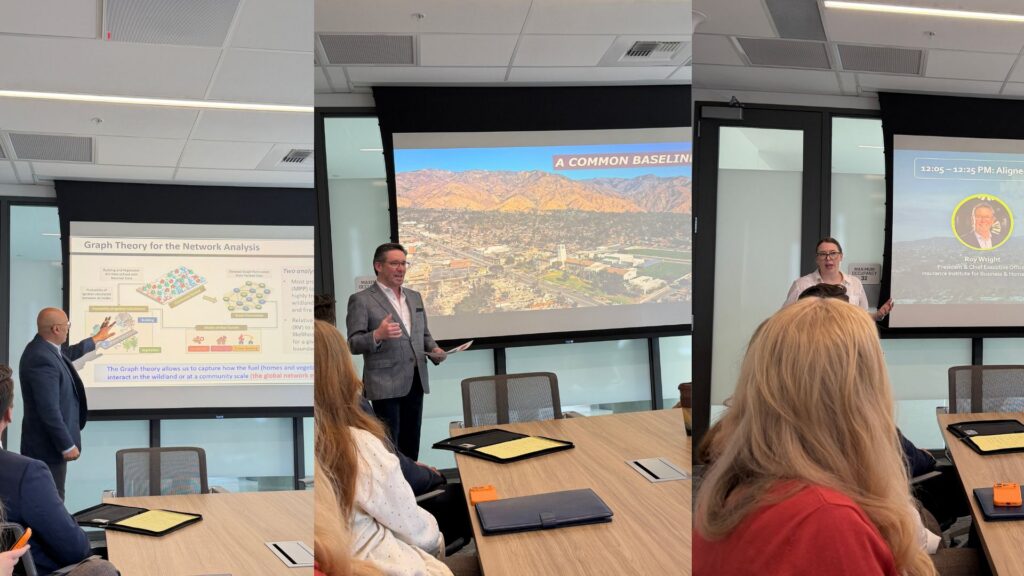
Those questions have been at the center of two recent legislative briefings convened by California Forward (CA FWD) and Resources Legacy Fund (RLF), as part of a 2026 legislative education series informed by the Community Wildfire Resilience Workgroup.
Turning wildfire risk information into action
The goal is not one number or model for every wildfire decision. Local governments, state agencies, and communities may reasonably rely on different measures depending on the decisions they face. What matters is enough common ground across standards, data, and metrics to support better decisions and track whether investments are working.
That was a central theme of CA FWD and RLF’s August briefing on risk-based decision-making and public investment. The discussion examined how wildfire risk is measured, how it can inform investment choices, and what data and metrics are needed to track progress.
When funding, staff capacity, time, and access to specialized technical expertise are limited, decision makers need to ask the right questions: What problem are we trying to solve? What solution best addresses it? How much risk could it reduce, and how will we know whether it worked? Better data and analysis can help answer those questions and direct resources where they can do the most to reduce risk.
Clearer answers to these questions can also create stronger signals about which mitigation actions are most effective and worth prioritizing.
Connecting mitigation and insurance
Insurance provides one example of how those signals can shape decisions.
At the May briefing on wildfire risk and insurance, experts examined how investment in risk mitigation can better support long-term insurability. For property owners, one challenge is understanding which actions are most relevant to their property, how much they can reduce risk, what they cost, and whether insurers will recognize them.
California has taken steps to strengthen that connection through the Department of Insurance’s Safer from Wildfires framework, which requires insurers to recognize specified property- and community-level mitigation measures in their rating plans.
That recognition can reinforce the value of mitigation, but insurance incentives can only go so far. Upfront costs can limit action, and many community-scale investments require coordination beyond the individual property level. Stronger risk-informed systems are still needed to help different actors direct limited dollars and decision-making power toward actions that meaningfully reduce risk.
Carrying these lessons forward
Taken together, the two briefings point to a larger opportunity: better wildfire risk information and tools can sharpen investment decisions, provide clearer guidance, and strengthen the connection between mitigation and the economic systems that need to recognize its value.
That challenge of turning wildfire risk information into action extends beyond this year’s legislative session, as California’s next governor and Legislature determine how to carry the state’s wildfire resilience work forward.
CA FWD, RLF, and Pacific Forest Trust recently released Wildfire Resilience: Strategic Action Plan for the Next Administration. The plan carries this risk-informed approach forward, calling for stronger decision-support tools, better data and conflagration modeling, and more deliberate targeting of limited public and private dollars toward risk-reduction outcomes.
This fall, the Action Plan will provide a starting point for further conversation at the California Economic Summit, October 13–15 in Long Beach, where wildfire leaders from across the state will test, discuss, and build momentum around priorities for California’s next chapter of wildfire resilience.
As California looks ahead, the challenge is to turn wildfire risk information into better decisions: set priorities, identify which mitigation actions are most effective in different places, and strengthen the systems that help people and institutions act on that information.
We are grateful to the experts who helped shape these conversations. The May briefing on wildfire risk and insurance featured Carolyn Kousky, Insurance for Good; Rex Frazier, Personal Insurance Federation of California; and Amy Bach, United Policyholders. The August briefing on risk-based decision-making and public investment for wildfire resilience featured Hussam Mahmoud, Vanderbilt University; Roy Wright, Insurance Institute for Business & Home Safety; Mike Peterson, California Department of Insurance; and Jacy Hyde, California Fire Safe Council.
About the Authors:
Taylor Carnevale is a Project Manager at CA FWD. She focuses on the fiscal implications of climate change for public institutions and the economy. Previously, Taylor served as a Climate Finance Associate with California IBank, the State of California’s “green bank,” where she supported the development and administration of financing tools to accelerate the deployment of climate technologies statewide.
Nuin-Tara Key is the Chief Operating Officer at CA FWD. In this role, she supports the overall strategy and development of programs across the organization. She has nearly 20 years of experience in climate adaptation and mitigation policy, climate finance, urban and regional planning, and social and environmental equity.