
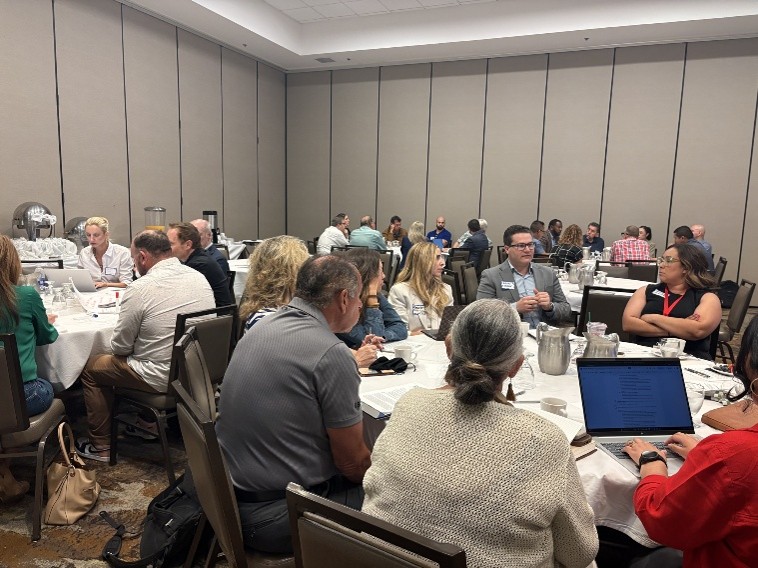
Fresno Regions Up Convening May 2026
By Darwin Moosavi
For nearly 20 years, CA FWD and our partners in the California Stewardship Network (CSN) have championed a “Regions-Up” approach: one where each of the state’s diverse regions has the tools, governance, and capacity to deliver on strategic priorities both within their regions and in Sacramento. Under Governor Newsom, the state invested over $1.4 billion into regional programs across California Jobs First, K–16 Education Collaboratives, and Regional Early Action Planning Grants 2.0, generating strong engagement, new strategic plans, and tangible projects on the ground. But many of those investments are now expiring or at an inflection point.
With a new governor entering office in 2027 and shifting legislative leadership, CA FWD and CSN believe the moment is ripe to build something more durable: a coherent system of state-regional collaboration that builds on what is working, reforms what is fragmented, and gives every region a genuine path to inclusive and resilient economic growth. To this end, CA FWD has led a series of discussions over the past year with partners throughout the state on what a durable economic development system in California could look like.
Long Beach Regions Up Convening May 2026
The Convenings
This spring, California Forward convened a diverse set of stakeholders across the state through roundtable conversations in Bakersfield, Oakland, and Sacramento, and held three larger convenings in Fresno, Long Beach, and Redding. Participants included leaders from workforce development, K–16 education, economic development, philanthropy, industry, regional and local governments, and community-based organizations. The goal of these conversations was to gather input and insight to shape key policy recommendations for the incoming governor and legislature on how to build a more durable, regions-up economic model here in California. Here is what we heard:
Key Themes
1. Regions need a consistent, aligned state voice and a front door to connect with state leaders
Across all three convenings, participants described a state government that speaks in many competing voices and at times with competing goals. Agencies operate in topical silos, and regions are left to navigate each one independently, with no single point of contact or coordinating authority. While there are a few people whose job it is to navigate across agencies, they often lack the authority to solve problems. Relationships built over years evaporate when staff turns over.
The stakeholders we heard from weren’t asking for a hotline or an information portal. They were asking for a “front door” to state government: a senior, empowered liaison who understands their issues and context and can move things across agency lines. They also want a seat at the table upstream, when priorities for programs are being set, not just downstream when calls for projects are announced and compliance is expected.
2. Funding cycles are too short, too siloed, and not aligned with each other
One- to two-year grant cycles make it nearly impossible to build sustainable programs. Organizations end up optimizing for spending, rather than outcomes. Agencies fund overlapping or competing work with mismatched metrics. Regions are effectively pitted against each other for small pots of state money when the real opportunity is coordinating to compete for larger federal investments.
Rural and smaller counties are also systematically disadvantaged by population-based funding formulas. As one participant put it, “equal distribution is not equitable distribution.”
3. Procedural implementation barriers are blocking real progress
Grant rules are complicated and shifting. Reimbursement timelines stretch years, disadvantaging smaller and less-resourced organizations that cannot carry costs upfront. Permitting and regulatory complexity act as structural barriers, not just an inconvenience. Technical assistance is often too generic to be useful. Regions need embedded, industry-specific expertise rather than generalized guidance.
Participants also raised the need for metrics that are appropriate for the different scales of regions. Ten jobs created can be transformative in a rural county and barely register in a major metro. State reporting requirements need to reflect the reality of regional diversity.
4. Regional governance bodies need ongoing funding and greater influence
Existing structures such as CA Jobs First, Workforce Investment Boards, and K–16 Collaboratives were key and foundational initiatives. Still, they have not reached their full potential because they lack ongoing funding streams or influence over state decision-making. Structures without meaningful authority or funding lose members and momentum fast.
There is a strong preference to build on what exists and works today, while working towards adding authority and resources to structures that already have trust and relationships in their respective regions. Participants also emphasized the importance of ensuring that private sector, industry, and local government become more active participants at regional tables.
5. Equitable representation and community trust must be foundational
In regional governance structures, smaller counties and rural areas are consistently overshadowed by larger neighbors. Tribal nations, community-based organizations, and trusted community members are often absent from the tables where consequential decisions are made.
Participants were clear that equity in representation is not the same as equity in outcomes; regional tables and funding decisions must account for both. Funding should flow to trusted community actors, not exclusively to credentialed intermediaries who may not have the same relationships with the communities they serve.
Key Solutions
Through the convenings, participants began to coalesce around key solutions to address these themes and issues raised. Here are some of the ideas that emerged from the discussions:
- Create a Regional State-Liaison Network. Deploy senior, place-based state staff across agencies to serve as funding navigators and cross-agency coordinators for each region.
- Mandate multi-year funding commitments. Make three- to five- year minimum commitments on major regional grants, including statewide implementation grants and operations and maintenance funding, instead of pilot-only, one-year funding programs.
- Authorize regional economic coordinating councils. Formalize regional coordinating entities with funding and planning authority. Build from the California Jobs First regional geography and existing infrastructure where it has been proven to work. Require cross-sector membership.
- Consolidate funding streams. Create a regional block grant to invest directly into regions and ensure regional discretion over deployment. Consolidate key workforce, economic development, and climate funding streams that support regional plan priorities into one funding pot and a consolidated application for state funding.
- Adopt scalable metrics. Reform performance metrics and funding formulas that reflect the size and capacity of each region, so that meaningful progress in rural and smaller counties is recognized and rewarded.
- Invest in shared data and embedded capacity. Fund a statewide regional data platform that regions can access and leverage, as well as a unified grant portal, so regions spend less time navigating bureaucracy and more time delivering results.
What Comes Next
One thing is clear from our conversations: California’s regions are ready, willing, and able to deliver, and there is no shortage of opportunity for the state to build on this momentum and to be a stronger partner. CA FWD and the California Stewardship Network will use these insights to directly inform a policy playbook being developed for the incoming administration, providing a practical roadmap for how California’s next governor can build a more durable, regions-up economic model that delivers a more sustainable, resilient, and inclusive economy for all Californians.