
By Nuin-Tara Key and Taylor Carnevale
The Community Wildfire Resilience Workgroup, convened in partnership with Resources Legacy Fund, brings together leaders across wildfire science, land use, insurance, finance, and community implementation to advance a coordinated, long-term approach to reducing California’s growing wildfire risk to homes, infrastructure, and other parts of the built environment — and to addressing the impacts on our economy, insurance markets, and public budgets.
Recent years have served as a stark reminder that wildfire risk exists in the built environment and local economies across the state — where people live, work, and rely on stable insurance markets and public services. Ember-driven fires, structure-to-structure ignition, and cascading economic impacts are exposing gaps in California’s risk management, capital allocation, and other systems. While the state has made meaningful progress on landscape resilience through more than $5.6B in investment between 2015 and 2023 and the leadership of the California Wildfire and Forest Resilience Taskforce, there is still a missing piece: a coordinated approach to reducing risk in and around the built environment and local economies, where communities are most exposed to loss.
Against this backdrop, CA FWD convened a cross-sector group of experts in Guerneville this October for a two-day retreat. Participants brought deep experience across wildfire science, land use, insurance, public finance, economic development, and more. The goal was to identify the most actionable and effective steps California can take in the next year to reduce risk in the built environment c and strengthen the fiscal and economic foundations that serve as a bedrock Californians’ wellbeing.
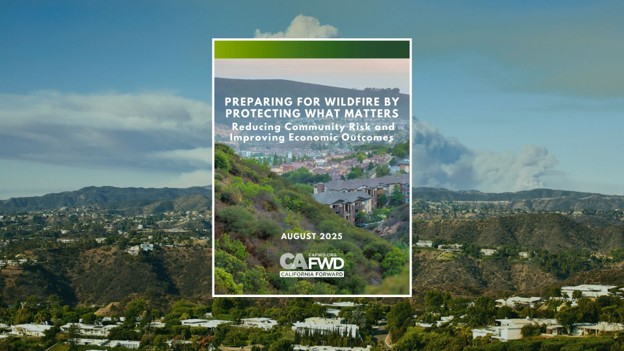
The retreat built on the release of CA FWD’s Preparing for Wildfire by Protecting What Matters, informed by convenings of wildfire experts and the spring Wildfire Policy Forum. The brief outlines five critical areas for reducing wildfire risk, supporting safer communities, and strengthening resilience:
- Tell the Story: Build credible evidence that connects risk reduction to avoided losses and public value.
- Enable Better-Informed Decision-Making: Improve the data and tools that shape policy and investment decisions.
- Empower Local and Regional Action: Close the gap between planning requirements and on-the-ground implementation.
- Develop Sustained Funding and Financing Solutions: Align capital with the scale and time horizon of wildfire risk.
- Ensure the State is a Stabilizer—Not a Substitute: Clarify public and private roles to rebuild confidence in insurance and capital markets.
Together, the brief and the retreat reflect a shared conclusion: California’s challenge is no longer defining the problem, but sending clearer signals, improving alignment across systems, and sustaining follow-through.
A Cross-Sector Coalition Filling a Critical Gap
Participants brought deep expertise across wildfire science, land use, insurance, public finance, building resilience, economic development, and community implementation.
Until now, there has been no single venue to align these perspectives around a coherent, practitioner-informed policy agenda. CA FWD convened this network to help fill this gap by creating a trusted space for subject-matter experts to convene with policy- and decision-makers to surface practical solutions and provide guidance on how California can reduce risk more effectively.
Looking Ahead
In 2026, the workgroup will focus on advancing three outcomes:
- Finance: Advancing capital pathways to support sustained, community-scale implementation, including home hardening measures
- Data, Mapping, and Modeling: Develop legislative and administrative actions to consolidate existing wildfire datasets, address critical gaps, and build decision-support tools that enable risk-informed planning, investment, and insurance decisions.
- Policy Playbook: Create a policy playbook for California’s next leaders to clarify priorities, roles, and early actions needed to sustain momentum through the state’s upcoming leadership transition.
Together, these priorities are intended to inform near-term policy and budget decisions, strengthen continuity across agencies and regions, and guide the next phase of California’s wildfire resilience strategy.
CA FWD welcomes outreach from policymakers, agency leaders, regional partners, practitioners, and community organizations as we translate these priorities into action.