
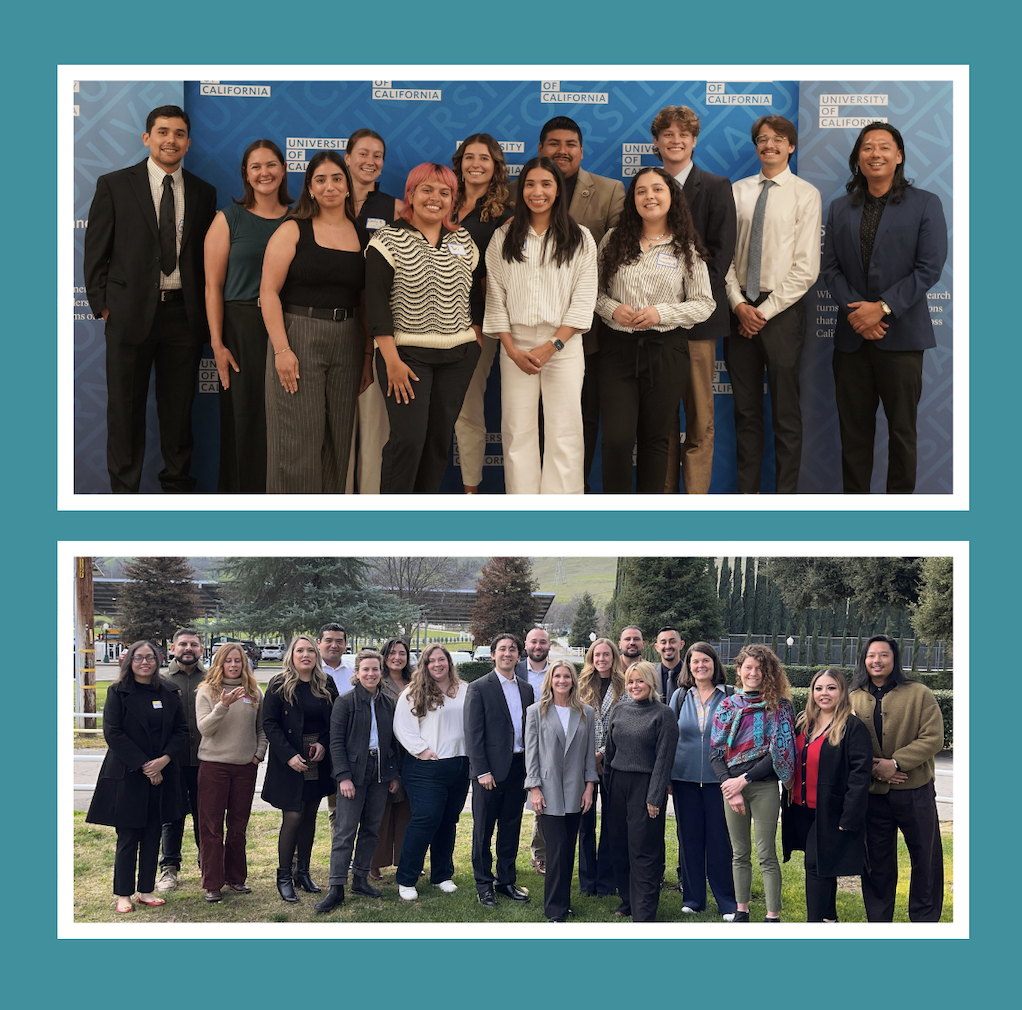
Members, past and present, of CA FWD’s Leadership Development programs
The second in CA FWD’s blog series with Microsoft TechSpark features questions submitted by members of CA FWD’s Leadership Development programs, providing an opportunity for these leaders to explore questions around AI, career pathways, and regional opportunities in California and receive actionable ideas and tips they can take back to their communities and organizations.
The Becky Morgan Steward Leadership Program is a mid-career program for leaders to deepen their understanding of regional and statewide policy issues and unite with peers from across the state to learn, grow, and build a better California; the current cohort includes leaders representing economic development corporations, municipal government, regional business councils, community foundations, and higher education.
The Young Leaders Program is an early-career program that elevates the next generation of industry, policy, and non-profit leaders and is made up of emerging leaders working across renewable energy, labor, local government, state policy, conservation, regional planning, higher education, mobility justice, and community organizing, spanning regions across California.
Thank you to Linda Nguyen from TechSpark for answering these questions from Emily Boettger, Sequoia Riverlands Trust (Young Leaders Program); priya v., California Community Colleges Chancellor’s Office (Young Leaders Program); and David Palter, Silicon Valley Leadership Group (Morgan Fellows program). Produced in partnership with Microsoft TechSpark, this blog does not necessarily reflect CA FWD’s views or programming.
1. How does Microsoft tailor TechSpark’s approach to different regional economies across California while addressing infrastructure challenges like broadband access and environmental sustainability?
TechSpark is built on the understanding that California is not one economy, but many. Our approach starts locally—by partnering with community organizations, local governments, and workforce leaders who understand the specific economic drivers and infrastructure gaps in their regions.
It’s important to stay relevant across dense urban areas, agricultural regions, and rural communities alike.
In rural California, we align closely with Microsoft’s Sustainable Connected Communities Initiative and statewide efforts like California’s Internet for All program. While public and private partners focus on building physical connectivity, we help ensure communities are ready to use that access to support digital skills training, nonprofit capacity building, and workforce pathways tied to local industries such as agriculture, logistics, and clean energy.
Environmental sustainability is approached in a similarly place‑based way. We support community‑based solar projects across rural and underserved parts of the state through partnerships that bring clean energy to schools, affordable housing, and community centers. These efforts improve grid resilience, lower energy costs, and create local jobs, which is an important intersection of sustainability and economic opportunity in areas facing climate and cost‑of‑living pressures.
Across California, we strive to connect the dots between broadband and workforce access, between sustainability goals and local jobs, and between statewide infrastructure investments and community‑level economic mobility.
By staying hyper‑local and partner‑driven, we help ensure that both rural and urban communities can fully participate in and benefit from the digital and clean‑energy economy.
2. What does equitable AI access require in practice, and how does Microsoft TechSpark reduce these barriers across California’s unique regions?
AI access requires more than access to a single tool. In practice, it depends on four foundational elements working together: reliable broadband, access to devices, inclusive design that accounts for language and disability, and practical skills training that helps people apply AI in meaningful ways.
Through a variety of different programs across California’s urban centers, rural communities, and tribal lands, TechSpark’s role is to connect these pieces into a system linking broadband, devices, inclusive design, and skills together.
A systems‑level approach helps ensure AI becomes a pathway to broad‑based economic mobility, not another barrier for communities historically left out of technological change.
One program I’m particularly proud of is our Microsoft Elevate AI skilling. We focus on practical, community‑driven AI skilling that supports nonprofits, small businesses, and workforce providers to apply AI in sectors that matter locally, from healthcare and education to agriculture, logistics, and climate resilience.
3. How can education systems and leadership development programs translate rapidly evolving employer needs into relevant AI curriculum fast enough to prepare students for an AI‑integrated job market?
Education systems can keep pace with rapid AI‑driven labor market change by moving away from static curricula and toward continuous, employer‑informed learning models.
What’s required is a tight feedback loop with industry and partnerships that align education with regional economic development.
Partnerships with labor organizations and education are critical. Collaborations with groups such as the North America’s Building Trades Union and the National Association of Workforce Boards expand the reach as the demands shift and shape. In addition, there is collaboration with the education ecosystem to ensure AI curriculum and leadership development are co‑designed with educators, supporting teacher and administrator readiness while creating direct feedback loops between classrooms and the job market.
At the regional level, economic development organizations help translate employer demand into place‑based training.
Through TechSpark, Microsoft partners with workforce boards, chambers of commerce, community colleges, and local nonprofits to align AI skilling with regional growth sectors—such as healthcare, logistics, agriculture, advanced manufacturing, and clean energy—so curriculum reflects real local jobs, not abstract national trends.
These efforts create a living talent pipeline—one where employers, educators, and economic development leaders continuously co‑create AI‑ready pathways. That’s how education systems can move fast enough to prepare learners not just for today’s AI‑integrated jobs, but for the jobs still being invented.
4. What gives you hope about AI’s potential to expand economic opportunity, and what concerns you most?
What gives me real hope about AI is its potential to be a powerful enabler of opportunity when it’s deployed thoughtfully. At its best, AI can lower barriers to expertise—helping small businesses compete, supporting educators and nonprofit leaders, and giving people tools that help them do their work better, not just faster. I’m hopeful because AI, when paired with access and skills, can broaden participation in the economy rather than concentrate opportunity.
When designed as a support—not a replacement—AI frees people to focus on the most human parts of their work: creativity, problem‑solving, relationship‑building, and care. That’s where I see its greatest economic and social value and what I’m especially encouraged by.
At the same time, I’m very clear‑eyed that this outcome isn’t automatic. AI reflects the systems around it. If access, skills, and inclusion aren’t intentionally built in, existing disparities can persist or even deepen.
Investments in broadband, education, language access, and inclusive design matter just as much as the technology itself.
Trust is another essential piece. AI is resource‑intensive, and as Microsoft leaders have said, it has to earn its social permission by delivering meaningful improvements in people’s lives—in healthcare, education, public services, and economic mobility. Economic growth alone isn’t enough; progress has to be broad‑based and tangible.
That’s where human‑centered and responsible AI comes in. Our approach emphasizes fairness, transparency, accountability, and inclusiveness—keeping people at the center of design and deployment.
The question is always: How does this technology expand human agency? How does it strengthen communities?
I’m hopeful because AI gives us an extraordinary opportunity to do things differently—to build an economy that’s more inclusive, more productive, and more humane. And I’m encouraged because there’s growing alignment across sectors that the future of AI has to serve the greater good, not just efficiency or scale.