
By Taylor Carnevale and Nuin-Tara Key
The Community Wildfire Resilience Workgroup, convened in partnership with Resources Legacy Fund, brings together leaders across wildfire science, land use, insurance, finance, and community implementation to advance a coordinated, long-term approach to reducing California’s growing wildfire risk to homes, infrastructure, and other parts of the built environment — and to addressing the impacts on our economy, insurance markets, and public budgets.
Wildfire is reshaping life across California: affecting housing affordability, insurance access, public budgets, and long-term economic stability. While the state has made historic investments in strengthening resilient landscapes, losses are ultimately realized in the built environment: our homes, businesses, infrastructure, and the local economies that depend on them.
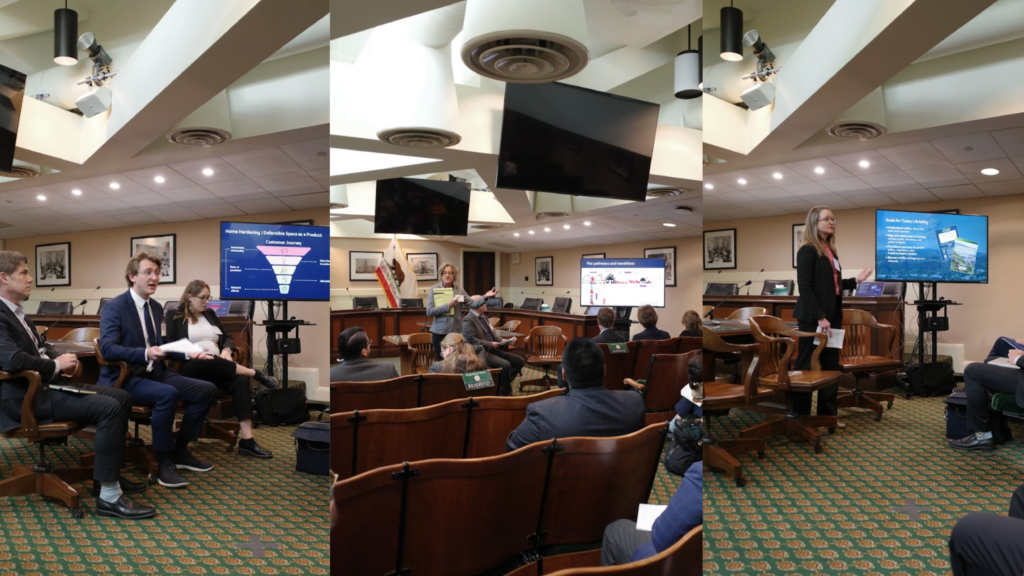
On January 26, CA FWD and Resources Legacy Fund convened legislative staff at the State Capitol for a briefing titled From Homes to Markets: Wildfire Risk in the Built Environment and Economy. The goal was to ground policymakers in a shared understanding of how wildfire risk manifests in communities and what it will take to reduce that risk in durable, fiscally responsible ways as the 2026 legislative session unfolds.
Building on Prior Work
Over the past year, CA FWD and Resources Legacy Fund have convened the Community Wildfire Resilience Workgroup, a cross-sector network of practitioners across wildfire science, land use, insurance, finance, and community implementation. The Workgroup was formed to address a persistent gap in California’s wildfire strategy: the need for a coordinated approach focused on reducing risk in communities and local economies alongside landscape resilience efforts. In 2026, the Workgroup is focusing on three areas:
- Finance: Advancing capital pathways that support sustained wildfire risk reductions— including home hardening and neighborhood-level resilience measures.
- Data, Mapping, and Modeling: Improving state policy maker understanding of existing wildfire datasets, identifying critical gaps, and improving decision-support tools that enable risk-informed planning, investment, and insurance decisions.
- Policy Playbook: Creating a policy playbook for California’s next Governor to maps a vision and set of recommended actions the state can take to improve preparedness and resilience to minimize damage from wildfire.
This briefing builds on CA FWD’s 2025 policy brief, Preparing for Wildfire by Protecting What Matters, and the Wildfire Policy Forum convened last spring. Together, that work reframed wildfire resilience as not only a fuels management issue, but also a governance, housing, insurance, and fiscal stability challenge.
The January briefing extended that foundation by connecting legislative staff directly with technical experts to explore implementation realities and policy implications.
A Shift in How We Frame Wildfire Risk
Speakers emphasized that wildfire risk is no longer confined to forests or rural areas. Ember-driven fires and structure-to-structure ignition can drive catastrophic losses in suburban and urban communities, creating cascading impacts on housing markets, insurance availability, utility systems, and public budgets.
Effective mitigation requires coordination across multiple scales:
- Home and parcel level, including home hardening and defensible space to reduce structure ignition.
- Neighborhood level, where development patterns, shared mitigation measures, and coordinated action influence fire spread.
- Community and infrastructure level, including evacuation routes, water systems, fuel breaks, and utility hardening that shape overall exposure and recovery.
These scales are interdependent. Policy and investment strategies that treat them in isolation will struggle to produce durable reductions in loss.
Catalyzing Action through Strategic Investment
The total cost of mitigating wildfire risk across California is significant. But the state does not need to bear the full cost to make meaningful progress.
California has demonstrated in other sectors that public dollars can catalyze private investment and household action. Speakers pointed to models such as rooftop solar adoption and energy efficiency retrofits, where targeted incentives, accessible financing, and clear standards helped unlock increased adoption. Targeted grants, accessible financing, clear standards, and verified mitigation pathways can reduce friction and unlock participation at scale.
At the same time, limited public resources make prioritization unavoidable. Investor-owned utilities are required to deploy formal risk-based investment frameworks, but comparable approaches are not yet consistently embedded across public wildfire resilience funding. Strengthening statewide risk modeling capacity and aligning grants, financing tools, and incentives with areas with greatest risk reduction potential can improve efficacy, strengthen stewardship of public funds, and enhance long-term return on investment.
The opportunity is to spend more strategically: leveraging public capital to drive scaled, coordinated action.
Informing the Next Chapter
As California moves through the 2026 legislative session and prepares for broader leadership transitions ahead, there is a window to align near-term policy decisions with a longer-term strategy for built environment resilience.
Durable progress will require coordination across agencies, levels of government, and sectors: grounded in a shared understanding of risk and a coherent approach to deploying capital and implementation tools
Wildfire risk in the built environment is not new. But aligning policy, capital, and implementation to reduce that risk at scale remains one of California’s most urgent governance challenges.
The Community Wildfire Resilience Workgroup serves as a resource for legislative staff and state leaders navigating these questions. If you are interested in connecting with the workgroup or learning more about this effort, we welcome the conversation.