
By Aaron Schreiber-Stainthorp, Director of Carbon Management, California Forward
California has long been a leader on climate change, including on measuring and managing the greenhouse gas emissions released across our economy, the same emissions driving more extreme wildfires and other climate impacts. In 2023, California went a step further. Two bills, SB 253 and SB 261, require companies doing significant business in California to publicly report what they emit and what climate change is likely to cost them. The goal is transparency: giving investors, customers, and the public a clearer view of how individual companies contribute to climate change, and how exposed they are to it.
One of these bills, Senate Bill 253, affects roughly 2,600 companies doing business in California with annual revenue above $1 billion. It requires them to report their full carbon footprint: what they emit directly, plus emissions from their entire supply chain. That reporting follows the GHG Protocol, a global framework that sorts emissions by how much control a company has over them. Scope 1 covers what a company burns directly: the natural gas in its boilers and the fuel in the trucks it owns. Scope 2 covers the energy it buys, mostly the electricity running its buildings and equipment. Scope 3 is everything else, and the furthest from direct control: the suppliers who make what it buys, the freight companies that move its goods, employee commuting and business travel, and, for many companies, the emissions customers create when they use the product. Each scope covers all greenhouse gases, not carbon dioxide alone. They are converted into a single common unit, metric tons of carbon dioxide equivalent, so the totals can be added together.
Take a hypothetical California company that makes frozen meals. Scope 1 is the natural gas fired in its ovens and the diesel in its own delivery trucks. Scope 2 is the electricity that runs its freezers and lights. Scope 3 is the farms that grew the vegetables, the mill that made the packaging, the trucking firm it contracts with, the flights its sales team takes, the power a customer’s freezer draws at home, etc. For most companies, Scope 3 is the largest of the three by a wide margin, and the hardest to measure, because nearly all of it happens outside the company’s own walls.
Under SB 253, the California Air Resources Board (CARB) asks companies to report Scope 1 and 2 emissions by November 10,2026 and will add Scope 3 reporting starting in 2027. CA FWD has been closely tracking public comments to CARB around how these disclosure rules are playing out through our CARB SB 253 Comments Tracker. It codes the full comment record: 637 comment points drawn from written and oral comments CARB has logged across its 45-day written comment period, a public workshop, six industry-specific listening sessions and public comment at CARB’s October 22, 2026 Board meeting. The tracker is not published, but CA FWD shares it on request. To request access, contact Aaron Schreiber-Stainthorp at aaron@cafwd.org.
The biggest takeaway from these 637 comment points is that the Scope 3 rule—the supply chain emissions companies worry they cannot easily measure or control0—faces little organized opposition in the rulemaking record. Most commenters are asking CARB how the rule will work. Here are three key findings and why they matter:
- 54% of public comment points ask for clarity rather than directly challenging the rule
- Of the comment points that do ask for a change, 83% ask CARB to scale the rule back: fewer categories to report, more time to comply, or lighter verification requirements
- Cost is a key concern, particularly for the smaller companies caught by the $1 billion threshold, which may not have in-house carbon accounting teams and would need to hire outside help. Some companies have submitted real cost data, but it covers different scopes and uses different definitions, so there is no clear dataset or average cost estimate available.
What we tracked
Most of the comment points focus on how the program will actually work. The four largest topic areas include:
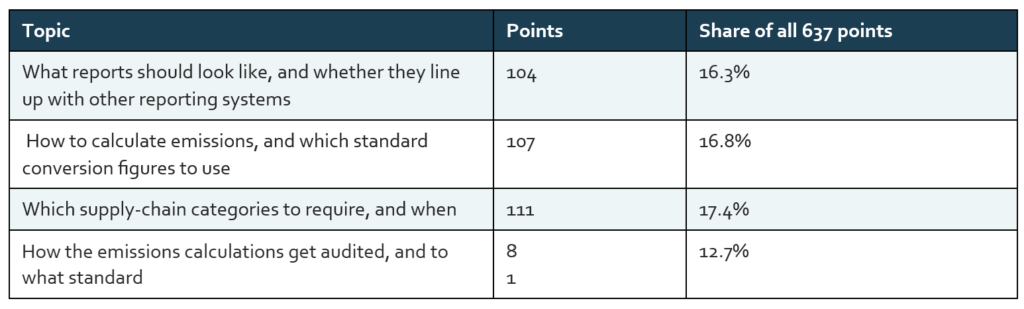
Source: CARB Comments Tracker, through October 22, 2026. The CA FWD Carbon Management team read every written submission and every session transcript, broke each into individual comment points, and checked the coding against the original letters and session recordings where available. The tracker records 637 comment points from 196 commenter units and 144 identified organizations, across CARB’s March 45-day written comment period, the July public workshop, six listening sessions and public comment at CARB’s October 22 Board meeting.
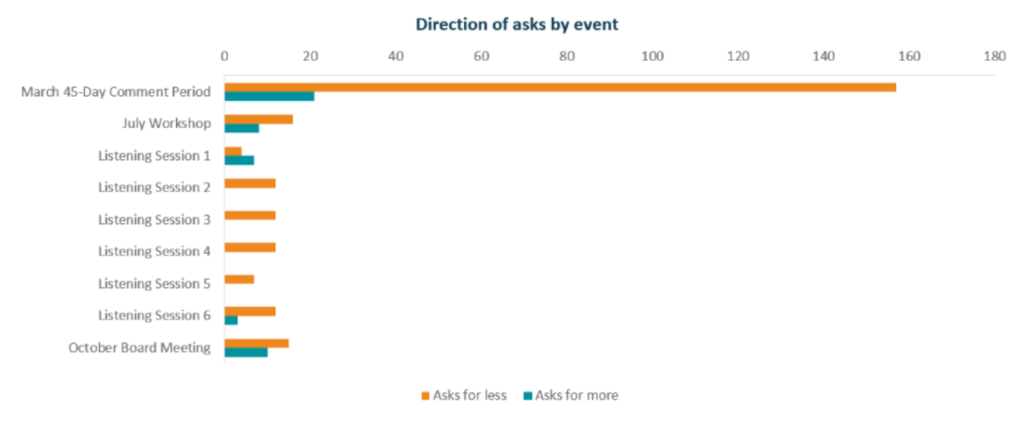
We also tracked which stakeholders spoke at each listening session. Advocacy groups accounted for 37% of the comment points in the first listening session and almost none in the industry-specific sessions that followed. This makes sense given that the other listening sessions were targeted towards different industry groups (i.e., banking, retail, agriculture, etc.). However, overall trade associations and companies account for 63% of all comment points compared to 13% for NGOs.
The graph below shows the same pattern in both the March written comment period and in most listening sessions since. Of the comment points asking for a change, 836% ask CARB to narrow the rule rather than broaden it. CARB staff told the Board on October 22 that they will hold another public workshop before bringing a formal proposal, which will open a second 45-day written comment period.
What the pattern suggests
Carbon accounting is complicated, and Scope 3 is the hardest part: it covers 15 categories of supply-chain emissions, and CARB is requiring only 5 of them starting in 2027 (purchased goods and services, fuel- and energy-related activities, waste, business travel, and employee commuting). The other 10 stay voluntary for now. CARB is also letting companies choose their own calculation method, as long as they show their work.
Going back to the example of the frozen meal company, under CARB’s approach, it would have to report the ingredients and packaging it buys, the waste from its plant, its business travel, and its employee commuting. The emissions from the trucks carrying finished meals to grocery stores, and from the freezers keeping them cold in customers’ homes, fall into the categories that stay voluntary.
The five required categories are the ones most companies already report, not necessarily the ones that matter most for a given industry. Patagonia made that case with its own numbers: two of its required categories add up to less than 1% of its Scope 3 emissions, while transportation-related categories CARB left voluntary can run 5 to 10%. In some industries, the gap is far wider. Carbon Disclosure Project’s sector analysis puts the emissions from burning the fuel that oil and gas companies sell at about 81% of their total footprint, and the emissions from driving the vehicles automakers sell at about 84%. For banks and insurers, the emissions tied to what they lend to, invest in, and underwrite come to more than 99% of their total impact. Every one of those sits in a category CARB has left voluntary. At CARB’s October Board meeting, Amalgamated Bank made the same point about financed emissions, and Pacific Environment asked CARB to set a reporting year for the freight categories.
What we see is that CARB is attempting to take a complex carbon accounting process and provide a lot of flexibility and onramps to give companies a chance to build data systems and processes. The pattern suggests that CARB wants to ensure a smooth transition to companies reporting their emissions and is prioritizing that over a complete emissions inventory.
There is still a lot of uncertainty about what a full greenhouse gas inventory actually costs a company to build. CARB has published its own estimates, and commenters have pushed back on them. Companies have submitted cost data, but it covers different scopes and uses different definitions, so there is no single comparable number. Business groups argue CARB’s estimates run too low. The Environmental Defense Fund and other advocacy groups argue any cost estimate should include the program’s benefits, not only its costs. Ceres made that case at CARB’s October Board meeting, citing a CalPERS letter that puts its annual cost of assessing fragmented climate information at $2.2 million.
CA FWD’s Carbon Management Program
CA FWD’s Carbon Management program helps California companies build carbon neutrality (decarbonization + carbon removal) into core operating decisions. We are working to make carbon accounting practical and actionable for California companies so they grow their business while reducing emissions.
SB 253 and rules like it require companies to report emissions, not to cut them, and a company can build a technically perfect inventory and still not use it to change what it buys, builds, or ships. Our two-year program works with California companies to close that gap: connecting carbon accounting to the sourcing, capital, and operating decisions that actually reduce emissions, not just the report that discloses them.
The SB 253 rulemaking will settle plenty of technical questions before it is final. The one it cannot settle by itself is whether the carbon accounting data companies are collecting will be used to drive business value and help them cut emissions, and that is the question CA FWD’s work picks up from here.
The Carbon Accounting Working Group
CA FWD is convening a Carbon Accounting Working Group of California companies and their suppliers around one question: what would it take for carbon data to change a real purchasing, routing or capital decision? In 2027, the group plans a procurement pilot that tests how supplier carbon data works to impact purchasing decisions and drive impact beyond reporting. Members help shape a pilot that CA FWD designs, and an independent research partner evaluates it, at no cost to members. The founding cohort is 10 to 12 organizations, kept small, so the room stays candid.
If your company reports under SB 253 or supplies a company that does, book a 30-minute call to learn more at calendly.com/aaron-cafwd or contact Aaron Schreiber-Stainthorp, Director of Carbon Management at CA FWD: aaron@cafwd.org.
We are grateful to Yuan Yang, a Stanford Fellow with CA FWD’s Carbon Management program in 2026, who built the CARB SB 253 Comments Tracker and developed the coding framework behind this analysis.