
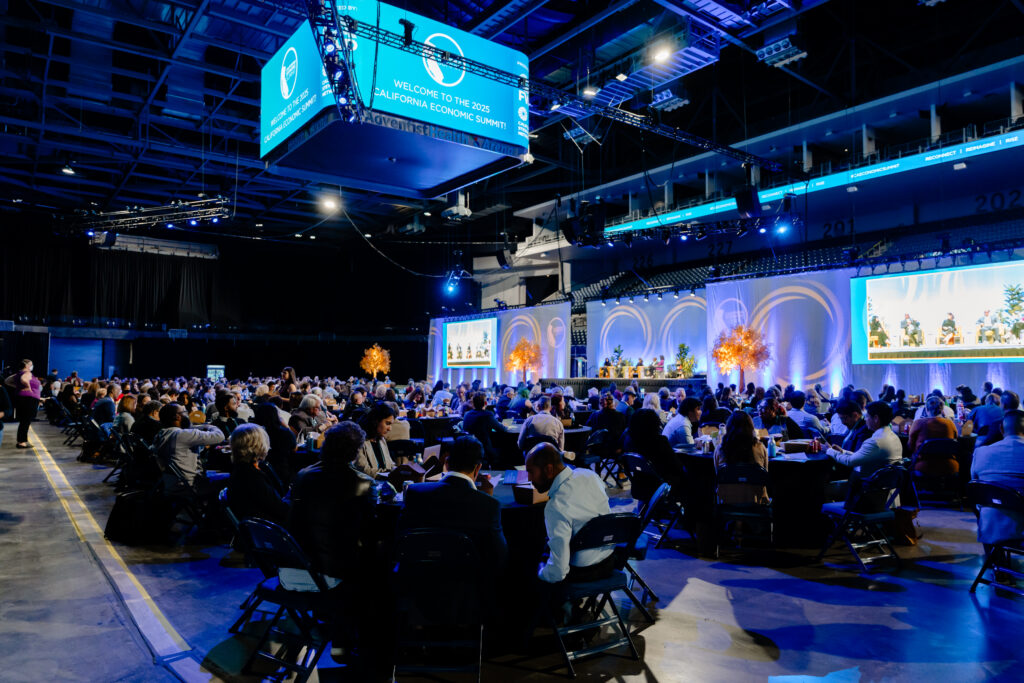
Scenes from the 2025 California Economic Summit in Stockton. Photo Credit: Alex Toro
CA FWD is thrilled to share more about some of our 2025 California Economic Summit sponsors and supporters, including the work they’re doing in California and how that aligns with our collective vision to build a resilient, sustainable, and inclusive economy. Today we feature an interview with Linda Nguyen of TechSpark, a community engagement program at Microsoft.
Q1: Tell us more about your work and what you do here in California?
I work in California because I believe deeply that technology—when paired with trust, skills, and community partnership—can open real doors to opportunity. Microsoft’s TechSpark initiative is grounded in the idea that digital skills are economic skills, and that access to technology training can change the trajectory of someone’s life. I’ve met Californians who moved from unstable, short‑term work into full‑time roles with benefits after gaining digital and AI‑ready skills through community‑based training programs supported by Microsoft, or completed trainings and participated in asynchronous skilling pathways to uplift and support pivots that people might want to make in their careers and lives. The California Economic Summit and CA FWD matter because they create the space for regional voices—educators, employers, nonprofits, workforce leaders—to come together and align around inclusive solutions. That collaborative, people‑centered approach reflects how we work every day: listening locally, investing intentionally, and scaling opportunity so more Californians can participate in the digital economy.
Q2: Why are you excited to support the California Economic Summit/CA FWD last year?
California is at an inflection point. Rapid advances in AI and automation, climate‑driven economic disruption, and long‑standing inequities are transforming how people work and how regional economies grow. Workers are asking how AI will affect their livelihoods. Small businesses are navigating digital transformation while trying to stay competitive and resilient. Communities are rebuilding economic stability after climate impacts. CA FWD plays a critical role by grounding statewide economic strategies in regional data and lived experience. That approach aligns closely with Microsoft’s commitment to responsible AI and digital inclusion—ensuring innovation moves forward in ways that are transparent, inclusive, and beneficial to people, not just markets. Connecting real regional insight to policy and investment decisions is how California builds an economy that is adaptive, resilient, and truly inclusive.
Q3: CA FWD’s vision is to build a New California Economy that is resilient, sustainable, and inclusive so people across every region and community can prosper—what are some projects you’re working on that align with those broad goals?
CA FWD’s vision for a New California Economy—resilient, sustainable, and inclusive—strongly resonates with our priorities. Economic growth only works when it’s shared. Microsoft has invested in expanding access to digital skills and AI‑era skilling pathways across California, supporting training in fields like IT support, cybersecurity, healthcare technology, advanced manufacturing, and clean energy. We’ve also supported broadband adoption and digital access initiatives in underserved communities, helping individuals, small businesses, and nonprofits fully participate in the digital economy. These efforts are about more than preparing people for jobs—they’re about economic dignity, lifelong learning, and ensuring Californians have the tools to shape their own futures in a rapidly changing world. That people‑centered vision is exactly what CA FWD is advancing.
Q4: What do you most want your fellow Summit attendees/the CA FWD audience to know about your organization?
Microsoft approaches our work in California as a long‑term community partner. We lead with listening, respect local expertise, and invest in solutions that are locally defined and locally led and building public private partnerships wherever and whenever possible. Through partnerships with community colleges, workforce organizations, nonprofits, and local governments, we support skilling programs, digital inclusion efforts, and responsible AI education that are trusted and built to last. Our goal is ambitious but simple: to ensure Californians—across regions, backgrounds, and communities—have the skills, access, and opportunity to thrive in the future of work. When technology, policy, and community leadership move together, a more inclusive and future‑ready California is not just possible—it’s achievable.