
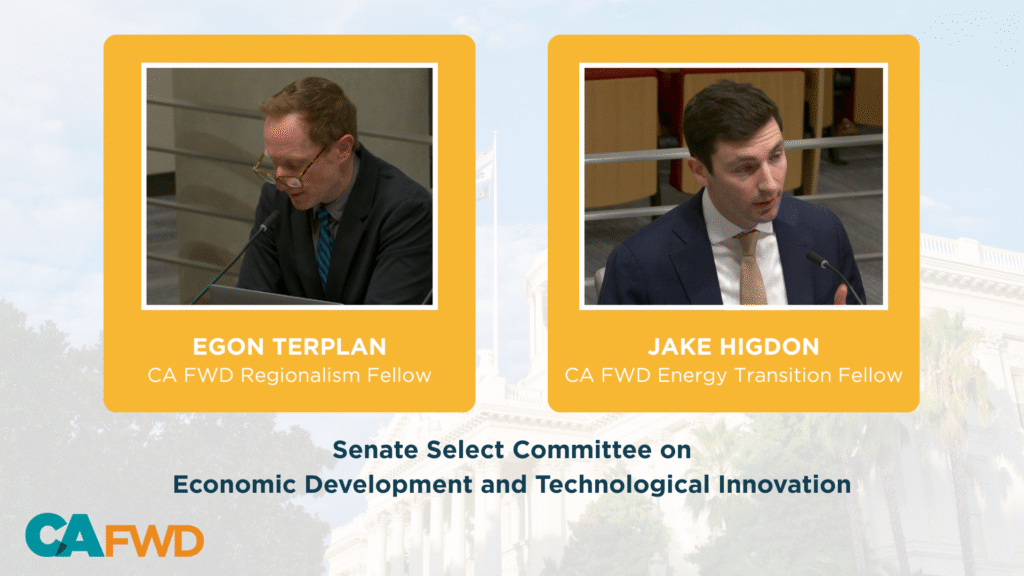
Last week, Egon Terplan, CA FWD’s Regionalism Fellow, and Jake Higdon, CA FWD’s Energy Transition Fellow, testified at the Senate Select Committee on Economic Development and Technological Innovation hearing on “Examining California Industrial Policy – Manufacturing and Economic Development,” providing testimony on California’s economic development system and regional industrial strategy. Below is a transcript of their testimony; you can watch a replay of the hearing here.
Testimony of Egon Terplan, CA FWD Fellow
Chair and Members, thank you for the opportunity to speak with you today. My name is Egon Terplan, and I serve as the Regionalism Fellow for California Forward, a multi-partisan nonprofit focused on building a New California Economy that is sustainable, resilient, and inclusive. Our work centers on economic growth through a regions-up approach, stewarding state resources, and building resilience in the face of climate and economic change.
Previously, I served as a senior advisor in the Governor’s Office of Planning and Research, where I helped set up the current framework for state and regional economic development in close partnership with GO-Biz. We initially called this work Regions Rise Together, which later became the Community Economic Resilience Fund and is now California Jobs First.
I’m here today with my colleague Jake Higdon, who will follow me and speak about industrial policy.
My goal this morning is to do three things:
- First, explain why California is not one economy, but a set of diverse regional economies — and why that matters for how we think about economic development.
- Second, describe how the state has responded by building a regions-up approach to economic development.
- And third, share what we’ve learned from that experience — including lessons from other states — and why it points to the need for a more durable state–regional structure going forward.
Let me start at the big picture. We often describe California as the fourth-largest economy in the world. That’s true in the aggregate — but it obscures a critical reality.
California is not one economy. It is a set of distinct but interconnected regional economies, each with different assets, risks, and trajectories.
In the same state, we have Silicon Valley’s globally competitive innovation economy; Kern County’s oil, gas, and renewable energy production; the Inland Empire’s concentration of warehousing and logistics; food processing and an emerging bioeconomy in the North San Joaquin Valley; and rural regions in the forested north and Sierra. Each of these regions experiences geopolitics, climate change, and automation very differently.
At the same time, California also has some of the highest levels of poverty and inequality in the nation – more than 7 million Californians lack resources to meet basic needs— and increasingly, that inequality is geographic, particularly between many coastal communities and inland areas. Educational outcomes and household incomes are double in some coastal regions compared with some inland areas.
This growing geographic divide is something the state began to take on about seven years ago — and COVID made the stakes unmistakable, as different regions experienced very different economic shocks and recoveries.
For many years, however, California was also tackling these issues within a fragmented system: workforce development, education, economic development on different tracks. Regions on their own. Competing programs and investments at the state level.
So we set out to pursue a deliberate strategy to better align state investments with regional realities – and to recognize there are opportunities to build on in every region of the state.
That’s why, starting in 2019, the state launched Regions Rise Together — an effort to ensure every region could leverage its assets and build a more resilient economy. Those ideas were then tested through the $600 million Community Economic Resilience Fund, now California Jobs First, alongside K–16 Education Collaboratives to better align education and workforce development with regional economic priorities.
The goals of this strategy were twofold.
First, economic mobility for people — especially in regions and communities that had been left behind. Research shows there are high returns when we invest in a full system that creates a clear pathway from education, through training, and into quality jobs — training people for jobs that actually exist.
Second, economic resilience for places — ensuring regions can adapt to competitive pressures, technological disruption, climate impacts, and global economic change, and that opportunities exist in the regions people come from.
As a result, California has made real and meaningful progress.
Today, the state is organized into 13 economic regions. Every region has completed a California Jobs First strategic plan. Every region has a K–16 Education Collaborative. Thousands of Californians — from business, labor, education, community, and local government — have participated in shaping these strategies. Regions are moving from planning to projects.
The state has also created a State Economic Blueprint, which identifies priority sectors where California can build long-term advantage.
This represents new civic and institutional capacity across the state — and for the first time, the foundation of a statewide system.
We’re also seeing concrete outcomes: $80 million invested by the state in 14 sector projects across seven regions, from the circular bioeconomy to space and defense; and $1.6 billion in 2025 investments that trained more than 142,000 workers and helped create over 61,000 jobs across California’s regions.
But we also need to be honest about the limits.
This structure worked very well in regions with strong existing institutions. In others, it was harder — not because of lack of commitment, but because regional capacity was uneven. And the system remains fragmented: too many plans, and too little coordination.
Most importantly, this was a one-time investment, not a durable system. The program was first announced at $750 million, funded at $600 million, and later reduced by $150 million.
That’s where looking at other states is instructive.
Most peer states have a dedicated economic development agency. Most make ongoing investments in regional economic development that build collaborative capacity over multiple planning cycles. And most have durable structures that consistently connect state priorities with regional action.
For California to manage the economic, climate, and geopolitical transitions ahead, we need that same kind of institutional muscle at both the state and regional levels — not one-time programs.
But durability alone is not enough.
We also need to intentionally grow strategic sectors — something we see clearly in other countries and increasingly in other states — if we want to support real economic diversification and bring quality jobs to all regions.
That’s the three-part system – better coordination at the state. Better coordination within regions. And new tools to deliver projects.
My colleague Jake will now go into more detail on the role of manufacturing in this ecosystem and what a California-specific industrial strategy can look like in practice.
Thank you.
Testimony of Jake Higdon, CA FWD Fellow
Chair, Members,
Good morning. Thank you for the opportunity to testify today alongside my California Forward colleague, Egon Terplan.
Egon laid out some of the history and theory behind an economic development strategy that brings together state leadership, regional coordination, and project-level execution.
I’ll be focusing my remarks on the role of industry and manufacturing in that strategy, and specifically, on clean industry and advanced manufacturing. In my role at CA FWD, I work on efforts to shift California’s economy towards the green industries of the future.
Now, CA has long been a manufacturing powerhouse… perhaps an underrated one. The Governor likes to tout the fact that CA is still the largest manufacturing economy in the U.S. This state is home to more than a million manufacturing workers.
But those raw statistics belie a broader trend. The state’s industrial muscle is eroding. In recent decades, California has increasingly found itself in a role of inventor of critical technologies, on one end, and consumer, on the other, but is missing many steps in that value chain. When you lose that middle, you lose an engine of inclusive growth. Manufacturing contributes to high-quality, stable jobs. It supports local tax bases, providing revenue for schools and other critical services. And it drives innovation as you go from a controlled lab environment to full-scale production. You learn by doing at each step of the way, you spin-off new techniques and businesses, and you build a workforce that attracts other manufacturers.
Our vision for green industrial policy revolves around the premise that certain manufacturing sectors and industries are not just a path to economic prosperity, but also critical to a resilient, durable energy transition.
Climate action is not a pen and paper exercise. It’s a matter of producing physical goods – steel, cement, wires, batteries, cars, trains, chemicals – and moving them around. Building the muscle to supply those goods will ensure we can achieve our state’s ambitious climate goals in the decades ahead. It is rare in the history of modern industrial development to have this kind of economic and environmental win-win.
One such win-win sector is the battery supply chain. We need them for our climate goals. We invented them in California. UC scientists have won Nobel prizes for developing Lithium-ion battery technology. And yet, the manufacturing has largely scaled up elsewhere, driving jobs, economic growth, and innovation spillovers outside of California. Those same CA-invented products then get shipped back into the state as one of the world’s biggest end markets for batteries. Today, we risk creating that same missing middle with the next generation of California battery companies like Sila, Lyten, and Antora.
When our CEO, Kate Gordon, and I were at the US Department of Energy during the Biden Administration, we consistently saw this dynamic. These maps are almost the inverse of each other. On the one hand, DOE programs were funneling tons of R&D dollars into the UC system, Berkeley national labs, and startups; on the other hand, California did not position itself as the home for supply chain scale-up.
In fact, I looked back at my database of BIL and IRA demonstration and deployment funding. Of 67 grants totaling nearly $8B for battery and EV manufacturing, only two small recycling demonstrations were awarded to CA – just $13M — less than a quarter of a percent of the total funding.
So, let’s say we want to take collective action to change this dynamic. What does a green industrial policy that fits within the state-and-regional economic development framework look like?
First, the state must take its Economic Blueprint a step further and develop sector-specific roadmaps that take a hard look at California’s assets and limitations, then align state resources to fill gaps.
Let me illustrate a specific example: The Economic Blueprint and Jobs First regions have identified the bioeconomy as a priority sector. It makes strategic sense. We have the nation’s greatest agricultural and forestry expertise, and we need to produce low-carbon bio-based products to replace things like petrochemicals and emissions-intensive building materials. We also need a market pull to ensure we conduct proper waste management and wildfire mitigation. Imagine a robust California bioeconomy that utilizes wood from forest treatments in the North State, or almond hulls from Central Valley farmers, to manufacture new, innovative, low-carbon products. The state, to its great credit, has provided a Jobs First grant to BEAM Circular’s circular bioeconomy innovation campus in Stanislaus County, filling a scale-up gap in the biomanufacturing ecosystem.
But what happens next? More is needed to solve challenges that individual regions and private companies cannot. What statewide action will be necessary to build out the bioeconomy over the course of years and even decades? How will we connect feedstocks with end markets, which could be in opposite corners of the state? How can the state drive demand for these new products to get over the valley of death?
This need for sector-specific roadmaps is why CA FWD supported SB 787 last year, and why we continue to endorse efforts to expand the state’s role in industrial roadmapping… and then put resources behind those industrial roadmaps. It’s also why we are doing our part to develop a statewide California bioeconomy roadmap of our own.
There are many other ways the state can actualize green industrial policy, from financing to demand-pull incentives, but I want to leave you with just one other recommendation: The need to empower California government to be a proactive industrial development partner. Industrial development should be in the state’s job description. In state employees’ job descriptions.
It’s not hard to imagine it, because lots of states do it. If you are a hard tech CEO, chances are, dozens of states are lining up to help you figure out where and how you build your factory.
California is just probably not one of them.
For strategic, priority industries that drive both economic prosperity and climate progress, partnership looks like building state capacity to help companies navigate permitting and other complex procedures, utilize existing industrial lands and assets, coordinate industrial hubs to minimize new infrastructure footprint, and more. Plus, in a time of electricity affordability and supply concerns, state action is necessary to ensure timely power access for manufacturers. If we are smart about it, we may even be able to leverage large industrial loads to reduce rates system-wide.
In closing: California is the best place in the world to invent new, clean tech. It’s the best market in the world to sell batteries and other low-carbon products. But we have this missing middle. We believe in the ends – a 100% clean economy – but we don’t produce the means.
If California wants to achieve an energy transition that is truly equitable, resilient, and delivers jobs and economic benefit across the state, we need to embrace industrial policy. I hope I have offered some inspiration for how to start.
Thank you.