The Opportunity and Challenge
California’s economy is at a crossroads. The world’s fourth largest economy, the state boasts incredible assets including our geography, natural resources, innovation culture, and human capital. At the same time, the state has some of the country’s highest inequality and poverty rates, a reality felt in both rural and urban regions. Meanwhile, the world faces unprecedented challenges from a fast-changing economy, shifting geopolitical priorities, and a warming climate.
California has the opportunity to lead the way on navigating these realities in a way that models a truly sustainable, resilient, and inclusive economic model for the modern era. Seizing that opportunity requires improved coordination, governance, and action at both the state and regional level, as well as new implementation tools to effectively deliver projects throughout the state.
For nearly 20 years, California Forward (CA FWD) and our partners in the California Stewardship Network (CSN) have championed a “regions-up” approach where each of the state’s diverse regions has the tools and capabilities to deliver on strategic priorities within their regions as well as in Sacramento.
Under Governor Gavin Newsom, the state has elevated and prioritized the role of regions, regional planning, and regional investments into economic and workforce development, integrated land use and transportation, housing, natural and working landscapes, and climate action–including directing over $1.4 billion into regional programs such as California Jobs First, K-16 Education Collaboratives, and Regional Early Action Planning Grants (REAP 2.0). Taken together, these programs resulted in strong stakeholder engagement and capacity building, new strategic plans across every region in the state, and tangible and transformative projects on the ground.
But these signature regional programs and related investments are each at an important juncture:
- The regional investments funded through California Jobs First are scheduled to sunset in 2026.
- The K-16 Education Collaboratives received only one-time funding.
- The Sustainable Communities Strategies (created in 2008 through SB 375) is being reevaluated to ensure the program truly meets its goals, while funds from the Regional Early Action Planning Grants of 2021 are also expiring.
- State programs insufficiently integrate climate resilience into economic and land use planning.
- Federal restructuring has dramatically reduced place-based investments into businesses and communities, putting pressure on state and local government and philanthropy to fill gaps.
With a new Governor entering office in 2027, as well as changing legislative leadership, it is critical to build on the progress of the past eight years and to further create an inclusive and resilient economy across every region of this great state. Rural and urban. Coastal and inland. North, central, and south.
CA FWD and CSN believe the time is ripe for a more durable system of state-regional economic collaboration–one that leverages new regional capacity and investments while addressing ongoing structural challenges such as fragmented regional tools, siloed planning processes, inadequate data systems, and lack of long-term programs and financing models. A new system that does not add layers of bureaucracy and process, but rather streamlines and organizes existing work into a coherent system that fosters strong and sustainable economic growth within and across our diverse regions.
The Approach
In early 2025, CA FWD and CSN launched a Regions-Up Workgroup, composed of regional civic leaders, California Jobs First and K-16 Education Collaborative conveners, CSN partner directors, CALCOG representatives, and independent experts. Over the past year, this group has:
- Identified why now is a ripe moment for Regionalism through an exploration of 8 opportunities.
- Studied regional economic development models from other states.
- Identified the opportunities and challenges facing program implementation.
- Developed, through discussion with hundreds of stakeholders including at the 2025 California Economic Summit, a draft of actionable policy and programmatic recommendations.
- Currently: Reviewing California’s history of regional planning and current program effectiveness.
In 2026, the Workgroup will go out on the road, testing draft recommendations and refining them into a policy playbook for California’s legislative leaders and incoming governor—all while building a statewide coalition to advocate for and implement a durable regions-up economic model.
Draft Recommendations include:
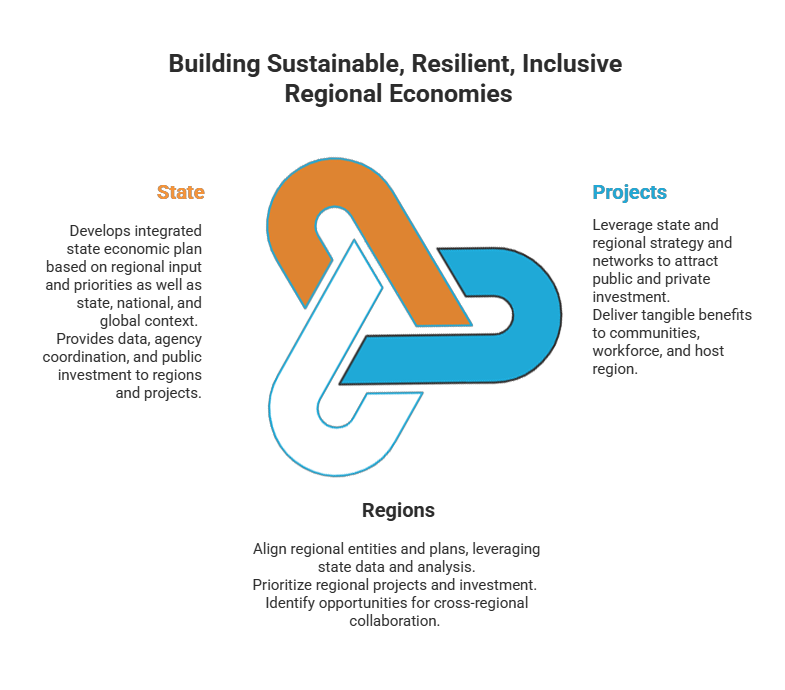
1. Create Clear State-Level Economic Development Governance
Goal: Lead and guide the world’s most innovative economy—with clear goals and an eye toward broader geopolitical, economic, and climate impacts—by improving coordination within state government, and providing ongoing resources towards economic development and diversification at the state and regional levels.
Key Activities:
- Identify specific options to better align and more effectively leverage state economic development activities, including the potential to organize existing functions into a cabinet-level economic development agency that explicitly aligns economic strategy with state climate, energy, workforce, and education goals.
- Strengthen state-level interagency coordination to integrate economic and workforce outcomes into other planning and policy priorities (e.g. climate, energy, housing, transportation)–and vice versa.
- Develop a process to continually update a comprehensive state economic strategy that includes a robust, resilient, and regions-up process–including regular evaluation, adjustment, and alignment with other state strategies.
- Hire state ‘ombudspeople’ living in, and with strong ties to, each region to coordinate across agencies and program investments, provide policy expertise, and ensure consistent implementation of state and regional strategies.
2. Support Durable Regional Governance Systems
Goal: Leverage existing regional institutions, agencies, and plans to support a more coherent and durable regional economic and workforce development infrastructure with clear roles, structures, and authority.
Key Activities:
- Design and pilot ‘Regional Economic Councils’ that leverage and strengthen existing collaboratives and regional governance structures (Economic Development Districts, Workforce Investment Boards, Metropolitan Planning Organizations, Councils of Governments, and other civic groups and planning agencies), while also filling capacity gaps within lower resource areas.
- Establish flexible structures for coordination and alignment across existing adopted regional plans including but not limited to California Jobs First and related Regional Investment Initiatives, Sustainable Communities Strategies, Career Education and Community College Consortia, and K-16 Education Collaboratives.
- Work across regional partners to identify priority projects and drivers for public and private investment, including: pre-permitted development zones and sites; technical assistance hubs; unified regional funding requests to state, federal, and private investors; and clear structures for durable community and worker benefits to ensure broader public benefits and support.
3. Develop State and Regional Tools to Enable Project Implementation
Goal: Provide regions and project developers with the financial resources, technical assistance, and regulatory authority necessary to move from planning to project execution while enhancing overall capacity for ongoing community capacity, project investment, and project delivery.
Key Activities:
- Provide consistent annual funding for the implementation of regional economic development plans.
- Design a consolidated state funding application that recognizes the full capital stacks needed to support projects (both public and private funding), drawing on models from other states and countries.
- Establish new funding tools and authorities to implement targeted economic growth strategies, including updated Tax Increment Financing and Resilience Districts, state-backed loan funds and other debt products at low or zero interest, cross-jurisdiction revenue sharing for industrial zones, zone-based incentives, and land transfer mechanisms.
- Create a state clearinghouse of economic development tools and best practices standards for investment, including toolkits for financing, permitting, and sector-specific playbooks tied to technical assistance and capacity-building.
- Develop a single online portal for state and regional economic, land use, and climate data relevant to economic development strategies and funding applications.
For more information and to track program progress, visit https://cafwd.org/regions-up/