
Lawmakers are deciding who pays for wildfire. The harder question is how the state stops paying more every year.
By Nuin-Tara Key, Chief Operating Officer, California Forward (CA FWD)
This year, California is on track to spend the least it has in decades on reducing wildfire risk, even as the state heads into what increasingly feels like a year-round emergency. That number belongs at the center of the wildfire debate now moving through the Legislature. Too often, it sits at the edge.
Lawmakers have until Aug. 31 to decide how the state divides the rising cost of wildfire among utilities, ratepayers, survivors, and insurance customers. It is a real and urgent question. It is also only half of the conversation California needs to have, and it is the more familiar half.
This session is the second act of a debate that opened last fall, when the Legislature and Governor Newsom reauthorized California’s cap-and-invest program. That deal included Senate Bill 254, which restructured the state’s wildfire fund, adding up to $18 billion split between ratepayers and utility shareholders and shielding billions more in prevention spending from utility rates. SB 254 also required a report from the California Earthquake Authority, released in April, on new ways to share the cost of wildfires and other disasters among insurers, utilities, homeowners and government. I served as a consultant on that report, and it is helping to shape the legislation under discussion today.
A durable solution has to satisfy groups that want very different things. Fire survivors want to be paid fairly and quickly. Ratepayers do not want higher bills. Utilities need certainty to keep investing in prevention. Insurers are working to keep coverage affordable.
It also has to do two things at once. In the near term, the state needs to fix how it splits wildfire costs and liability so the system is more stable and fair. Over the long term, the only way to bring costs down is sustained investment in reducing risk on the ground, from clearing vegetation to hardening homes. Both matter, and one cannot substitute for the other.
The wildfire fund was built in 2019 to let utilities cover wildfire liability without going bankrupt and to give fire victims a path to compensation. The January 2025 Los Angeles fires came close to draining it. A fund designed narrowly around liability was never built for a future of more frequent and overlapping disasters, from wildfires to floods to extreme heat. This session is a response to a system that needs structural change, not simply a fight over who pays how much.
The choices in front of lawmakers center on how much responsibility utilities carry when their equipment starts a fire and how much of the fund’s cost shifts onto customers. One key question is whether easing what utilities owe will actually translate into more investment in prevention. Whatever costs utilities do not cover tend to land on electric bills or insurance premiums, and both feed back into how expensive it already is to live in California.
At CA FWD, we believe risk reduction should be the foundation of any wildfire cost plan rather than an afterthought. A lasting solution reduces risk at the source. Reshuffling who pays for the risk that already exists does not.
But, in spite of the State’s progress on wildfire resilience over the last decade, this work is getting harder to fund. Since 2019 the state has invested an average of $590 million annually for wildfire mitigation, but this year could see the lowest levels of investment in a decade. Last year, the state moved wildfire prevention to the lowest priority tier within cap-and-invest. Current projections show roughly $38 million available for wildfire and forest programs next year, down from previous allocations of $200 million a year. The bond funding through Prop4 that has filled the gap is expected to run out by 2028-29.
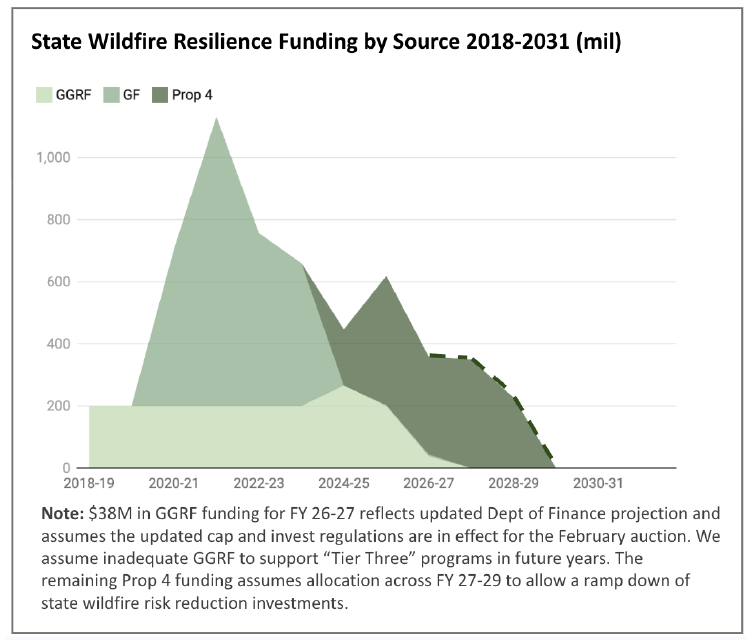
Source: Developed by Violet Low-Beinart at the Pacific Forest Trust based on data from the Legislative Analyst’s Office.
Without sustained investment in reducing risk on the ground, changing who pays for wildfire costs will not bring those costs down over time. The real test for any proposal is whether it holds up across several fire seasons, not just whether it solves this year’s crisis.
The question for this session is whether California can build a way of sharing wildfire costs and risks that lasts, across fire seasons, rate cases and future legislative sessions, rather than rebuilding it every year or, worse, in the middle of a disaster.
For more on how these pieces fit together, tune in to our recent podcast episode.