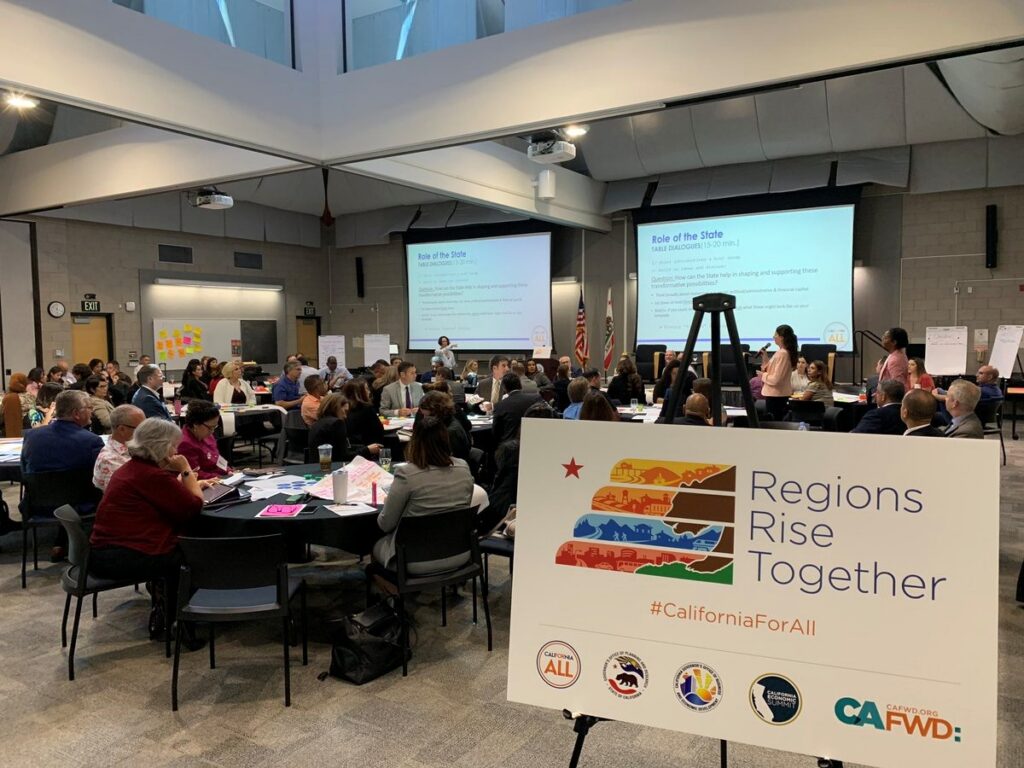
A Regions Rise Together convening in 2019, in the Inland Empire at CSU San Bernardino
Executive Summary
Between 2019 and 2026, California committed nearly $1.5 billion for a deliberate experiment: could California model a new kind of regional economic development focused not on transactional project-by-project investment, but on broader issues of regional prosperity, economic mobility, and climate resilience? These investments built on decades of prior work supporting regions and regionalism and included three major programs: the Community Economic Resilience Fund (CERF, later rebranded as California Jobs First), the K-16 Education Collaborative Grant Program, and the Regional Early Action Planning Grants of 2021 (aka REAP 2.0). Together, these programs tested an important hypothesis: that the State of California and its regions could become genuine partners—and models to the world—in solving interconnected challenges across economic and workforce development, land use and transportation integration, and economic resilience in the face of increasing geopolitical and climate shocks. While the experiment proved the regions-up model is viable, it also exposed key challenges. Institutional durability, cross-program alignment, ongoing political commitment to invest in regions, and uneven civic capacity and collaborative history across regions remain unresolved challenges across California.
This white paper documents that experiment from both an inside and outside-of-government perspective. In the initial years of the Newsom Administration, I served as Senior Advisor for Economic Development and Transportation at the (then) Governor’s Office of Planning and Research (OPR), now Office of Land Use and Climate Innovation (LCI). Since then, I have worked directly with several regions as well as continued supporting the regions-up model through California Forward, which was a partner in designing and advocating for these regional investments from the beginning.
In this paper, I trace how the leadership at OPR, our partner agencies in economic development (the Governor’s Office of Business and Economic Development, or GO-Biz) and labor (the California Labor and Workforce Development Agency), and the Governor himself worked to articulate an initial theory of change, tested that theory through program design and implementation, and learned what works—and what doesn’t—when investing in a regions-up model in a state as diverse and complex as California.[1]
Our original vision from 2019, called “Regions Rise Together,” was for “inclusive and resilient economic development and sustainable land use and transportation planning across California and its regions.” Our goal at that time was to create a more prosperous and inclusive economy that would be better prepared for the various climate transitions, by tackling these complex interrelated issues where they are felt – at the regional scale. The process we imagined was for a broad cross-section of leaders in every region in California to craft a comprehensive economic strategy that leveraged existing local and regional plans, and then to partner with the state on its implementation as part of an enduring state-to-regional structure. Through subsequent investments, most notably the response to the economic and workforce shocks from COVID, we were able to make major investments in all of California’s regions across multiple programs.
As many throughout California and the United States look at models for regional planning and implementation, especially in a world seeing increased economic and climate disruptions, it is important to examine the origins of these programs to see how the vision matched the reality, and to learn how to adjust these models for subsequent programs and investments.
It is my intention that this will help inform current and future decisionmakers in California and beyond as they shape regional or economic policy at the national, state, regional, or project levels.
If there’s one core message of this report, it’s this: After nearly eight years of sustained focus on regions, now is the time to double down, not pull back. While there’s messiness in trying to create collaborative plans with a diversity of voices, and to invest in policy and planning systems that do not match traditional city and county lines, the ability to work across these silos is precisely what’s needed to solve our increasingly complex economic and climate issues.
The programs documented here prove that a regions-up model works, not perfectly, but well enough to demonstrate that regions can organize across differences, align institutions, and leverage state investment for transformative projects. They also reveal something else: while the block grant model helped equalize access to state funding, regions with deeper civic capacity and collaborative history were consistently better positioned to attract additional private and federal investment. Sustained investment in a regions-up system is therefore not simply about extending existing programs. It is about refusing to freeze the current state of inequality in civic capacity and political power across California’s regions and giving every part of the state a genuine opportunity to benefit.
Done right, a durable regions-up system will better leverage public dollars, drive private investment, and support a more resilient and inclusive California, now and into the future.
Timeline: Key Milestones in recent California Regions-Up efforts
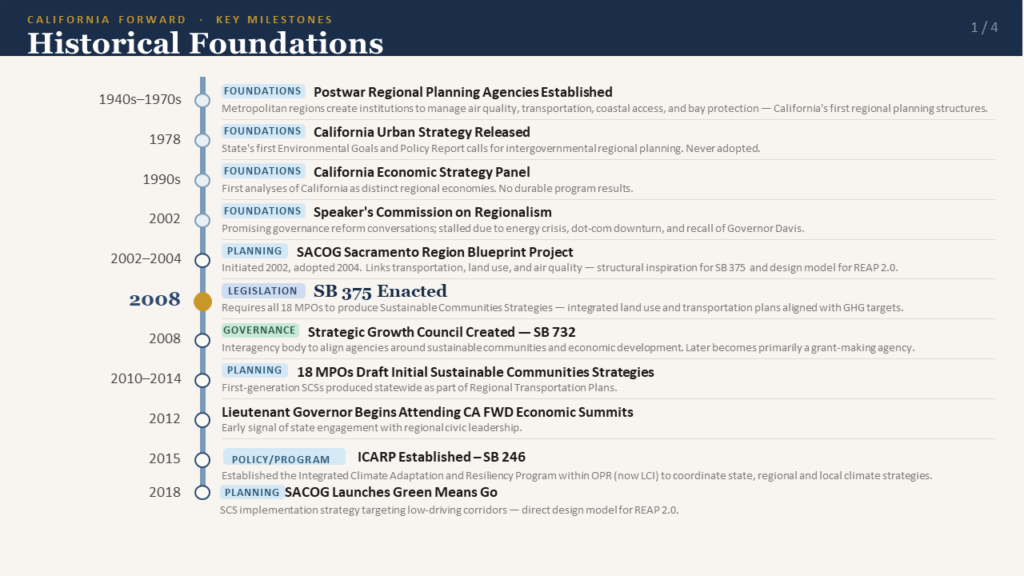
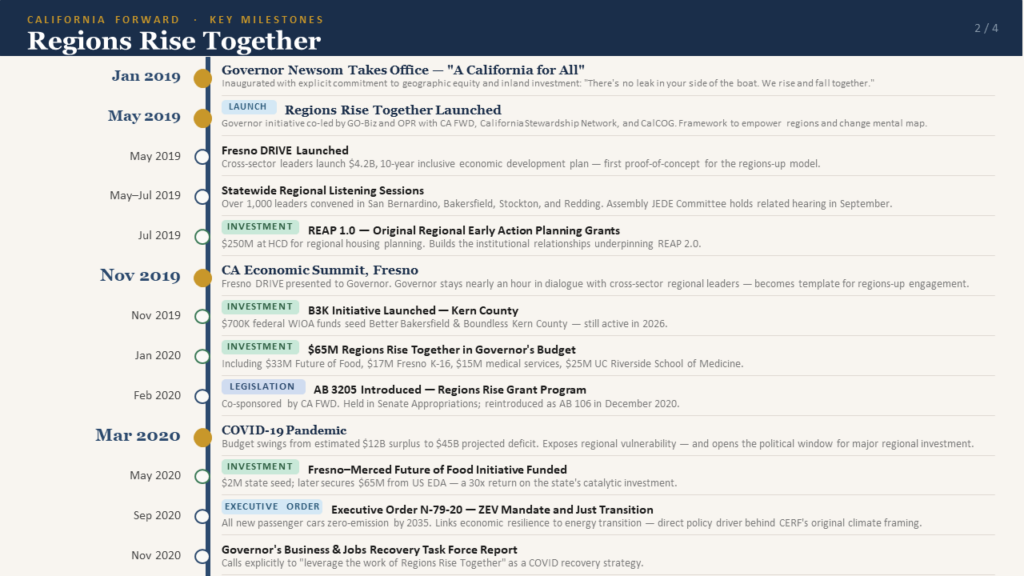
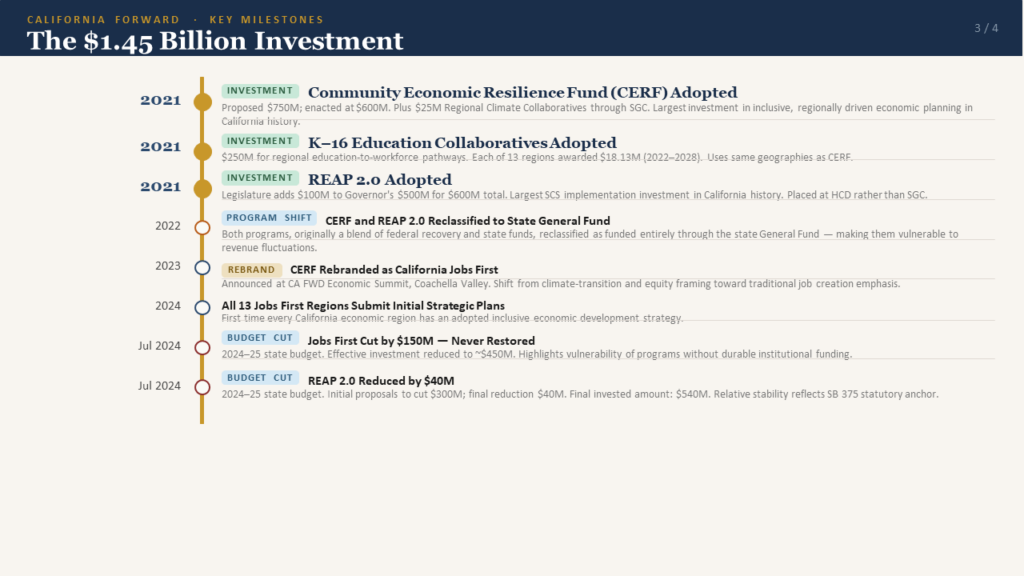
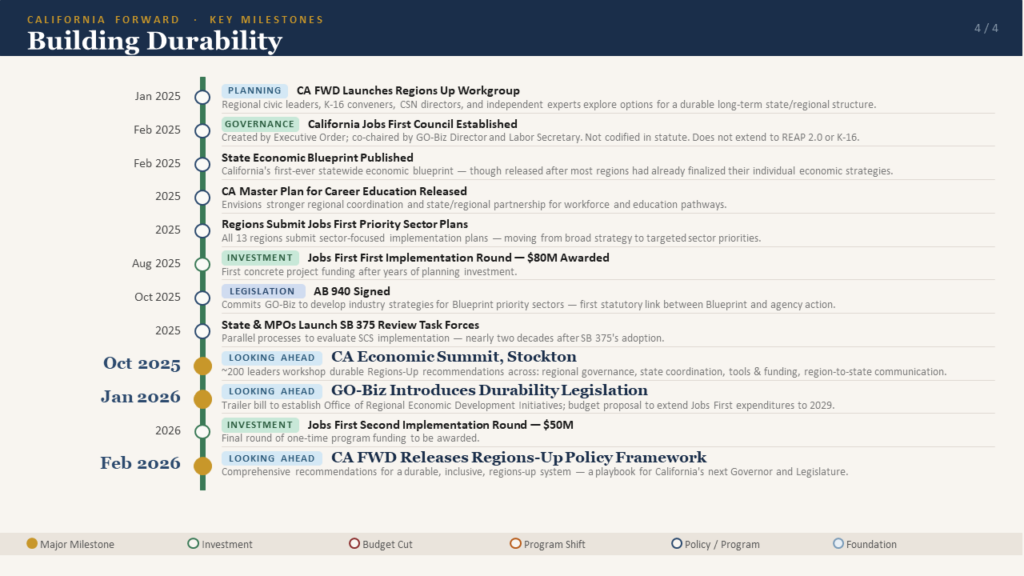
Source: CA FWD research
Introduction
Given its sheer size and geographic diversity, California has long been a place that requires regional policy and solutions to solve core issues. The economic needs in the rural forested north are invariably quite different from the urbanized Los Angeles region; same for the tech-focused Bay Area versus the agricultural heart of the Central Valley. As a result, advocates, researchers, civic leaders, and policy leaders have long sought to help California more effectively solve policy issues using a regional lens. This means preparing economic plans focused on regionally competitive sectors, focusing housing locations and transportation investments on specific travel needs of each region, and managing the intersection of population and economic growth with growing land use considerations and climate impacts that inevitably cross jurisdictional boundaries.
When Governor Newsom was sworn into office in January 2019, his administration ushered in a renewed focus on regionalism and tested a new approach to regional investment in California. Starting in 2019 with the Governor’s Regions Rise Together initiative, the state pursued an intentional strategy: empower regions to define their own priorities, align the state government and regions across agency and topical silos, and fund not only planning but actual project investment and implementation.
This approach to regional policy in the Newsom Administration’s Regions Rise Together relied on decades of work on regional planning and regionalism. But the Governor broadened and connected some of these past efforts towards a comprehensive approach to regions, one that recognized the interconnections between inclusive economic development, sustainable land use, and the growing imperative of climate resilience.
California’s Unfinished History of Regionalism
Throughout California’s history, regionalism has generally emerged in response to crisis rather than through proactive state planning. When local governments lacked the ability to manage emerging challenges — or when those challenges transcended local boundaries — regional action became a viable option. Air pollution, local waterway and bay protection, economic transition, open space loss: in each case, leaders recognized that the scale of the problem could not be solved within a single jurisdiction, and some new form of regional collaboration or institution resulted. This pattern repeated across policy domains and across decades: the nation’s first regional air pollution agency in the Bay Area in 1955; the nation’s largest metropolitan planning organization in Southern California (191 cities) formed as a joint powers authority in 1965, an 8-county San Joaquin Valley Air Pollution Control District formed in 1991; saving the San Francisco Bay in the 1960s (which led to the creation of BCDC); greenbelt protection, urban growth boundaries, land trusts, and habitat preservation in the decades since.
In economic development, the state’s one-time Economic Strategy Panel analyses in the 1990s produced important regional cluster analyses and data-driven strategies for California’s distinct regional economies. In land use and transportation, Sacramento Area Council of Governments’ Sacramento Region Blueprint process, adopted in 2004,[2] pioneered integrated regional scenario planning, forming the direct inspiration for SB 375 (2008) which required Metropolitan Planning Organizations to produce combined land use and transportation strategies known as Sustainable Communities Strategies. In workforce development, the federal Workforce Innovation and Opportunity Act (WIOA) drove successive rounds of regional coordination among workforce boards and training providers. In climate resilience, California’s Integrated Climate Adaptation and Resilience Program (ICARP) supported regional planning and implementation, recognizing that climate impacts are felt and must be addressed at the regional scale. Regional climate impacts are analyzed through the California Climate Change Assessments. Successful regionalism in California has often – though not always –emerged regions-up, not top down. Regionalism emerges because there is a crisis to respond to or an opportunity to seize that no single city or county can address alone.
Yet the success of these regional efforts has long been constrained by two chronic weaknesses. The first is uneven capacity across regions. Metropolitan areas developed decades of experience with cross-jurisdictional institutions, philanthropic investment, and cross-sector civic infrastructure. Rural regions, by contrast, faced deep distrust of state authority, limited staff capacity, dispersed geographies, and historic exclusion from state planning efforts like SB 375, which only applied to regions with formally designated Metropolitan Planning Organizations. Rural regions rarely had the tools or resources needed to compete for state and federal grants against higher-capacity metropolitan governments. Too often rural regions lacked regional forums in which to develop shared priorities. (This is why regional civic capacity like that created through the California Stewardship Network, is so important).
The second chronic weakness is episodic state support. At every stage in California’s history, the state has articulated powerful ideas about regional integration, such as in the Urban Strategy of 1978, the Speaker’s Commission on Regionalism in 2002, and the 2015 Environmental Goals and Policy Report (EGPR). But rarely has the state stayed the course to ensure ongoing investment or true authority for regional action. State support emerged in waves, tied to crises or political windows, and then receded. The fact that the EGPR is legally required but rarely published is evidence of this inconsistent support. Each of these prior efforts formed part of the foundation for tackling a core issue at the regional level. Each also showed that regional plans without dedicated implementation funding or an ongoing partnership with the state tend to stall. This lesson would directly shape the design of the programs that followed.
A further structural problem compounded both weaknesses: the tendency to create regional institutions focused on a single policy issue (e.g. air quality, transportation funding, shoreline protection, workforce development) without any mechanism for managing the conflicts and connections across those systems. California developed a patchwork of regional agencies, each with its own mandate, geography, and funding stream, but no overarching framework for integrating economic development, land use, climate resilience, and workforce needs at a shared regional scale. The result was a regional governance landscape rich in specific expertise but thin on integration, and one in which the very programs designed to address regional challenges often deepened the fragmentation by adding yet another siloed institution to an already crowded field.
This history matters because it defines the problem that the Newsom Administration inherited in 2019. The state had built real regional capacity in specific domains: MPOs managing transportation, air districts managing pollution, workforce boards managing job training, civic intermediaries managing cross-sector dialogue. But it had never built the connective tissue to make those systems work together toward shared goals, either within individual regions or between the state and its regions collectively. Geographic inequality between coastal and inland regions was growing. Climate pressures were intensifying. And the structural fragmentation that had long defined California’s approach to regionalism meant that no existing institution was positioned to tackle these interconnected challenges at the appropriate scale.
Regions Rise Together was not simply a new initiative. It was the latest in a long series of attempts to break a chronic California pattern: visionary regionalism followed by institutional stall.[3] What made it different, as the following pages document, was the scale of political will behind it as well as the investment that ultimately followed.
There were two key initial drivers of the strategy within Regions Rise Together and the subsequent investments. First, the need to address the persistent and growing inequality between coastal and inland regions, as well as within individual regions.
Second, the need to prepare regions for a more resilient future as they confront economic risks including climate threats, demographic changes, globalization shifts, and industry restructuring. The shock to supply chains and regional economies from the COVID-19 pandemic underscored the state’s vulnerability and reinforced the motivation for investment in regional economies. It is not likely the Legislature would have funded the regional investment approach taken in subsequent legislation in the absence of the stark regional economic impacts from COVID.
In the language of economic policy, the Newsom administration in its first term pursued a combination of “people-based” and “place-based” approaches. This meant securing economic mobility for people — especially in regions and communities that had been left behind. Research shows there are high returns when government invests in a full system that creates a clear pathway from education, through training, and into quality jobs — training people for jobs that actually exist, while investing in the success of the industries creating those jobs. At the same time, it meant economic resilience for places — ensuring regions can adapt to competitive pressures, technological disruption, climate impacts, and global economic change in ways that allow for people to stay and work in the places they are from or choose to live.
In 2021, the state promised over $1.45 billion[4] in commitments to regions; this was far more than any prior regional investment efforts. The regional programs differed in priority and structure. But all included a mix of guaranteed regional block grants and statewide competitive implementation funds. The goal was to drive both planning and implementation toward an integrated approach including new regional economic plans, workforce pathways from kindergarten through college, and existing but underpowered regional land use plans.
Throughout this paper, I explore this regional investment model, with an eye toward understanding what worked well and what could have been structured or implemented more effectively. This work is part of a broader CA FWD regions-up initiative, which seeks to bring specific policy proposals to the next California Governor and legislative leadership, with the goal of building a more durable structure for state-regional partnership, coordination, and long-term investment in California’s regions.
This examination of recent history, combined with countless conversations between CA FWD and state, regional, and local leaders over the past five years, points to four lessons:
1. California must prepare and plan for continued transitions – demographic, economic, and climate-related.[5] Transitions are inevitable, unevenly distributed across regions, and unfold over long time horizons, requiring planning and implementation capacities that extend beyond short-term programs or funding cycles. Geographic inequality was identified as a central challenge in 2019, became acute during COVID’s uneven economic impacts, and remains critical as California confronts accelerating climate risks and shifting fiscal realities. Regions and economies will confront impacts and must manage transitions on a continuous basis. The question is whether we can establish long-range planning and investment functions at the state and regional levels that can jointly support communities as they face transitions over a decade within 2-year budget cycles.
2. Regions are the appropriate geography for integrated planning and action, and the right scale at which the state can realistically engage. Given California’s size and diversity, solving the state’s interconnected economic, workforce, and climate challenges requires a regions-up model where regions are empowered to work in partnership with the state. Regions are not only where the impacts of state policy are most directly felt, but with the right governance structures in place, they are uniquely positioned to tackle interrelated issues that operate at a regional scale: industries and supply chains, labor markets, housing markets, climate impacts, and travel patterns.
3. Implementation requires durable institutional structures at both the regional and state levels. One-off initiatives, pilot projects, and temporary collaboratives can generate momentum. But without enduring governance and coordination mechanisms, their impacts are difficult to sustain. The regions-up model over recent years invested in building new civic capacity at the regional level (Jobs First regional tables and K-16 Education Collaboratives) and also strengthened interagency coordination at the state level (the Jobs First Council). To achieve durability, the regional civic capacity and state interagency coordination require not only ongoing financial commitment, but also durable political support. At the state level, durability requires both a commitment to interagency coordination and staffing for agencies to effectively work across silos—for example, aligning different pots of funding toward shared goals. At the regional level, coordination requires entities with appropriate funding and authority—whether civic organizations (e.g. the California Stewardship Network), federally-recognized regional structures (e.g. Economic Development Districts), and/or regional government agencies (e.g. Metropolitan Planning Organizations and Councils of Government, where they exist) to meaningfully engage with the state and local stakeholders to deliver projects and enhance the regional ecosystem.
4. Planning must lead directly to implementation through dedicated funding, new approaches to project selection, and new tools for project delivery. Regional strategic plans bring people together around common issues. But without dedicated resources and effective tools, the plans are not implemented, leading to a decline in funding appetite and political will.
5. The differences in institutional readiness and civic capacity across regions require use of both guaranteed funding (block grants) and competitive investments. Across California’s regions, there are significant disparities in the history of cross-jurisdictional efforts, civic infrastructure to implement priority projects over the long-term, and resources to apply for state grants. Some regions have decades of experience working as a region and with the creation of public and private institutions to organize civic action (e.g. Sacramento) while others are only now beginning to forge partnerships across counties and institutions necessary to support regional action (e.g. North San Joaquin Valley). Effective investment programs will not benefit all regions equally unless there is intention in how they will operate in the distinct regions. A durable regions-up model should ideally include a mix of block grants or guaranteed funding to each region alongside statewide competitive grants that encourages all regions to put forth their highest priority projects.[6]
These lessons did not emerge neatly or in sequence. They were tested, challenged, and refined through seven years of program design, political negotiation, budget cuts, and regional implementation. What follows is the story of how California’s most significant regional investment in history came together—and what it means for the future of regional governance in the state.
The Launch of Regions Rise Together (2019-2020)

This flyer presented a high-level summary of Regions Rise Together, during its launch in 2019; Photo Credit
Gavin Newsom has often articulated a simple message about the state’s interconnectivity: “There’s no leak in your side of the boat. We rise and fall together.”[7] The notion was that we cannot succeed as a state if one area is struggling—but also that all areas of California have inherent economic value and deserve investment. Starting during his 2018 gubernatorial run, Newsom was clear that this applied especially to inland regions that felt ignored by prior administrations. His frequent visits to the Central Valley and other inland areas signaled a genuine commitment to geographic equity.
Once elected, the Governor tapped Lenny Mendonca to run the Governor’s Office of Business and Economic Development (GO-Biz) and Kate Gordon to run the Governor’s Office of Planning and Research (OPR, which is also home to the interagency Strategic Growth Council, or SGC) – both of whom brought direct experience working across diverse regions toward common goals. Together with their senior advisors (including myself, who was hired specifically to work on inland California economic development), they co-led the Governor’s vision for inland investment and regional economic development. With a nod to the Governor’s early speeches on regional equity, we called this effort “Regions Rise Together”.
Regions Rise Together was officially launched in May 2019[8] and was structured as a joint project of GO-Biz and OPR, with implementation support from external organizations, most prominently California Forward (CA FWD), the California Stewardship Network, and the California Association of Councils of Governments (CalCOG).
Regions Rise Together was launched without any funding, as an effort to reframe California as a collection of interconnected regions. The initiative aimed to reshape how state agencies, regional institutions, and civic leaders not only talked about California’s economic geography, but also recognized the region as the essential scale for both policy investment and cross-sector coordination. This effort sought to correct what state leadership viewed as a structural weakness: the absence of durable mechanisms for aligning economic development, land use, transportation, and climate action at the regional scale, particularly outside coastal metropolitan areas. It also addressed the lack of long-term interagency planning at the state level to help regions achieve their goals.

The Regions Rise Together convening in Redding in October 2019, focused on the North State
Three Pillars of Regions Rise Together
Regions Rise Together was grounded in three core pillars:
- Changing the Mental Map of California
- Promoting Regions-Up Planning and Partnerships
- Improving Connections Across Regions to Link California
The first pillar was deceptively simple: The big coastal metros (e.g. the Bay Area, Los Angeles, and San Diego) receive the bulk of attention from public and private investors. Meanwhile, the state’s inland and rural regions are often overlooked.[9] To change the mental map meant seeing opportunity within and across all regions. This was a challenge to state leaders, agency staff, and philanthropy—most of whom came from Coastal California—to recognize that every region possesses assets and potential, even those that have been historically under-resourced. This pillar also represented a broadening of the state’s discourse on opportunity and equity by explicitly naming inequality across regions as a core economic issue, in addition to economic inequality within regions.
This pillar included multiple strategies and aspirations:
-
- Encouraging philanthropy and investors to invest more in inland California, including leveraging the federal government’s newly established “opportunity zones” (OZs).
- Encouraging the Governor’s Office of Appointments to source appointees from all regions, especially areas with less representation on boards, and commissions.
- Facilitating peer-to-peer learning between regions and communities, e.g. holding convenings of High-Speed Rail station cities from Bakersfield and Fresno to San Jose and Los Angeles to work on shared approaches to station area planning.
- Encouraging California-based companies in growth industries to consider locating new facilities elsewhere in the state, rather than only looking to commercialize outside California.[10]
The second pillar, on regions-up planning and partnerships, signaled support for a move away from transactional, project-by-project economic development and toward inclusive regional strategies. The term “regions up” was deliberate: priorities had to come from stakeholders within each region, not from the state down. The state’s role was to support and institutionalize cross-sector civic partnerships and empower regional coalitions to define their own agendas.
This regions-up pillar was based on the idea that regions are most effective when they bring diverse actors together to map regional assets, challenges, and opportunities across multiple systems. This meant encouraging all regions to convene business leaders, labor, community-based organizations, local government, educators, and civic intermediaries around a shared strategy. While at times difficult, this notion of multi-stakeholder economic development had been tried and tested in numerous regions, including the Inland Empire through the Inland Economic Growth and Opportunity (IEGO) and was being launched in Fresno in 2019 through Fresno DRIVE (see below).
Regions across California had also been developing integrated land use and transportation plans for more than a decade. Some Metropolitan Planning Organizations were exploring innovative models for aligning regional investment with local priorities, such as SACOG’s Green Means Go program, which targeted infrastructure funding toward low-driving corridors, and the Bay Area’s Priority Development Areas framework, which concentrated growth in locally designated centers.
State leaders reinforced this idea of cross-sector leadership and regions-up action by traveling to regions, holding listening sessions, and making clear that they wanted regions to bring forward their own priorities. Between 2019 and early 2020 more than 1,000 leaders from across the state came together in a series of hearings, with particular emphasis on inland regions. (Sessions were held in San Bernardino, Bakersfield, Stockton, and Redding). These engagements were designed not only to surface local priorities, but to test whether diverse stakeholders could begin to articulate shared regional strategies to better integrate economic development, workforce, infrastructure, and climate resilience—an early stress test of the three-pillar framework in practice.
Meanwhile, the legislature was holding related hearings. Specifically, the Assembly’s Committee on Jobs, Economic Development, and the Economy (JEDE) convened the third in its series of information hearings in September 2019 (in Corona) where they learned about regional initiatives and sought to examine solutions to income inequality. At that hearing, representatives from CA FWD highlighted “Regions Rise Together” as an initiative “designed to bring together diverse leaders in every region of the state over the course of the next year in order to develop an inclusive and comprehensive plan that would lift every part of California.”
The third pillar—strengthening the connective tissue between regions—recognized that no region is an island. Infrastructure systems such as broadband, water, higher education, transportation (including rail), and housing link regions together—as do increasingly frequent and severe climate impacts. The pillar highlighted that the state has a critical role in increasing alignment across agencies and funding streams so that investments in one region can support broader statewide economic resilience—and that sometimes the state needs to step in to highlight cross-regional imperatives where no single region is able to see the larger picture. This cross-regional view was essential for addressing complex challenges such as wildfire, drought, interregional commute patterns, industry transitions, and supply chain logistics. This interconnective tissue idea also reinforced the role of the state’s long-range planning.
Key investments supporting this third pillar of regional interconnective tissue include:
- High-speed rail throughout the Central Valley and its linkages into coastal southern and northern California.
- Public higher education (UC, CSU, Community Colleges) and their interconnection.
- Seamless mobility, through the California Integrated Travel Project (Cal-ITP).
- Climate-related investments through the state’s cap-and-trade program, into both decarbonization strategies like EV charging infrastructure and into climate resilience initiatives like the 2024 Climate Bond.
Early Outcomes and the Fresno DRIVE Proof-of-Concept
Fresno was prepared and ready to respond rapidly to the new focus on regional planning and implementation. The community had spent many years strengthening their community engagement and multi-sector leadership, in part through investments from the Strategic Growth Council’s[11] Transformative Climate Communities program, and private philanthropy targeting programs to the region. Leveraging this work to create a more inclusive table, Fresno County leaders – most notably former Mayor Ashley Swearingen, also a longtime board member of CA FWD and member of the California Stewardship Network – led a design and policy sprint starting in the late Spring of 2019 called Fresno DRIVE (Fresno Developing the Region’s Inclusive and Vibrant Economy). The goal was to have a comprehensive proposal ready in time for CA FWD’s CA Economic Summit, which would take place in Fresno that fall with a major speech by the Governor. During the design sprint a cross-sector group of leaders prioritized 18 strategies as part of a $4.2 billion, 10-year inclusive economic development plan focused on mobility, workforce, innovation, and community wealth-building. The Fresno DRIVE blueprint was ultimately presented to the Governor in a unified and impressive show of cross-sector leadership—business, labor, community, environmental justice, and higher education. While the Governor was initially only scheduled for a brief meeting with the Fresno delegation as it happened in the middle of disruptive power system shutoffs and wildfires, the Governor ended up staying for nearly an hour in dialogue with the expertly organized cross section of the Fresno region, speaking in near unison about the need for investment in a more inclusive economy.
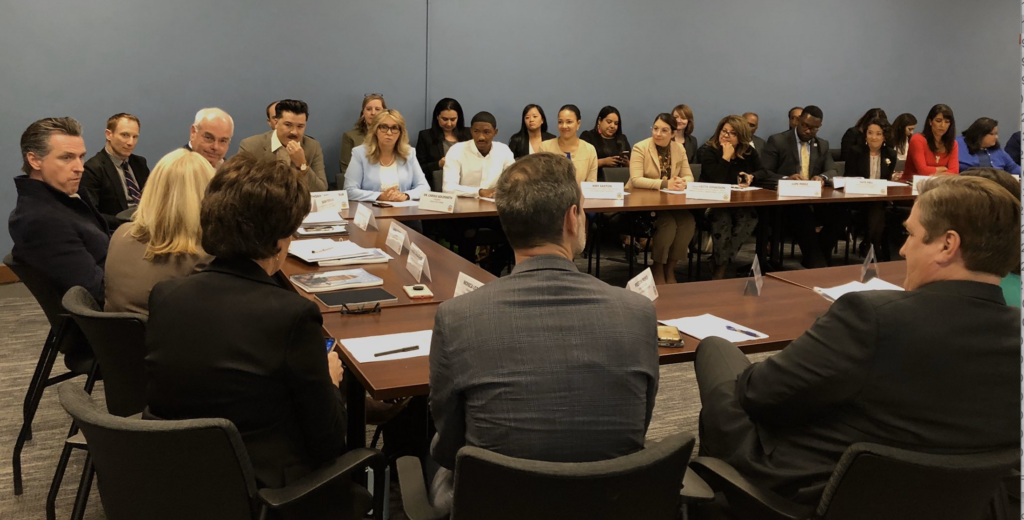
A Fresno DRIVE meeting with Governor Newsom in November 2019, which was the proof of concept for the regions-up model
The Fresno DRIVE process and presentation to the Governor became a template for future regional inclusive economic development efforts. What it demonstrated was the regions-up model in action: cross-sectoral civic leaders working regionally and across silos to identify priority investments, organize across differences, and present a clear package of priorities. The message to other regions was that the state would be a willing partner and co-investor if regions could organize and present a unified set of priorities.
Inspired by the Governor’s excitement around Fresno DRIVE, leaders in other regions also wanted state investment in inclusive strategies. Leaders in Kern County came to the Governor’s office in November 2019 to also make the case for investment in their community. Based on some quick internal responsiveness, the Governor’s team secured $700,000 in federal Rapid Response funds through the Labor and Workforce Development Agency to invest in an economic development initiative in Kern. This was the launch of what came to be known as “Better Bakersfield and Boundless Kern County” or (B3K Prosperity). This initiative launched later in 2020 and is still ongoing in 2026.
As an initial proof point of this model, the Governor’s proposed 2020-2021 budget ultimately included an entire section on “Regions Rise Together.” This provided an early signal that regional priorities could translate into state investment decisions. Fresno alone was slated to receive $65 million to support Fresno DRIVE priorities ($33M for the Future of Food Innovation Corridor, $17 million for a “Fresno Integrated K-16 Education Collaborative” (proposed but not funded), and $15 million to expand medical services). Also included was funding for GO-Biz regional staff and $25 million for expanded enrollment at the UC Riverside School of Medicine. Together this represented a unique targeted focus on inland California and a test case for state co-investment in regional priorities developed through inclusive planning.
The same budget recognized the importance of integrating various climate-related investments to provide better alignment across agencies, with the state’s first-ever “Climate Budget” including support for a range of initiatives to decarbonize the state while investing in climate resilience. The $12 billion, 5-year strategy included aligned funding and financing to scale regional resilience investments across the state, including:
- A climate bond for capital investments that reduce risk from wildfires, extreme heat, and other climate impacts across the state, support for major infrastructure projects intended to steward water and energy resources.
- Complementary general fund investments in local and regional adaptation planning and capacity building, as well as funding for the Fifth California Climate Change Assessment.
- Funding for the first-ever “Climate Catalyst Fund” to drive investment into new industries focused on the transition to a decarbonized economy—both examples of statewide infrastructure intended to support stronger and more resilient regional economies.
Then COVID hit.
COVID shutdowns two months after the release of the Governor’s proposed 2020 budget radically changed the state’s priorities, attention, and immediate fiscal outlook – with stark budget volatility swings of an estimated $6B surplus in the January 2020 budget to a projected $45B deficit by the May revise that year.
Ultimately, the final adopted 2020-2021 budget still included a $2 million investment to launch the Fresno-Merced Future of Food (F3) Innovation Initiative. (Subsequently, this initiative secured over $65 million from the US EDA as one of 21 winners of its national Build Back Better Challenge, representing a 30x return on the state’s initial catalytic investment.) The state’s climate bond, focused on regional climate resilience, was put on hold – as were the other complementary general fund investments – although pieces were ultimately taken up by the legislature and passed as Proposition 4 in 2024.[12] The Catalyst Fund also survived, though initially without funding.
But internally, the approach to expand economic plans faced skepticism. Some administration officials argued the state shouldn’t fund collaborative planning, only concrete “shovel ready” projects. The tension between investing in regional capacity versus focusing on individual projects would resurface throughout the implementation of CERF and other programs, including the state’s resilience investments.
Despite COVID’s disruptions, the conceptual foundation of Regions Rise Together carried forward. The initiative’s emphasis on regional planning, inclusion, and cross-sector collaboration became the basis for the design of future programs, most notably a new approach to resilience and economic recovery.
For example, during the Governor’s Task Force on Business and Jobs Recovery (which was formed in April 2020), we worked closely with the McKinsey Global Institute on an analysis of COVID’s uneven geographic and industry impacts, which was presented directly to the task force. The task force’s final report, released in November 2020, then called for the state to “leverage the work of Regions Rise Together” and pursue “inclusive regional strategies that leverage each region’s assets and mix of industries.”[13] This recommendation reflected that the core ideas of Regions Rise Together could form an important part of the state’s recovery from the economic impacts of COVID.
Regions Rise Together also functioned as a narrative intervention. The initiative emphasized the interdependence of California’s regions and elevated inland regions as critical to the state’s economic and climate future. This narrative shift was reflective of the “changing our mental map” pillar and was accompanied by tangible institutional signals. For example, in 2020, philanthropic partner Irvine Foundation committed over $135 million over seven years to priority communities to support inclusive economic development.
In addition, Regions Rise Together formed the basis of a key piece of state legislation that set the groundwork for the Governor’s investments to come.[14] Assemblymember Rudy Salas first introduced AB 3205 “Regions Rise Grant Program” (co-sponsored by CA FWD) in February 2020. It was held under submission in Senate Appropriations. A variant of that bill was then reintroduced in December 2020 by Assemblymember Salas as AB 106. The program focused on reducing disparities with and across regions, and the need for “inclusive consensus-based strategies to address barriers and challenges confronting communities in creating economic prosperity for all.”[15]
While the bill passed all committees unanimously, it did not advance in its original form. In particular, the Salas bill lacked attention to energy transition and climate resilience needs for regions. As is further explained below, the bill was ultimately rewritten into a broader approach to regional economic development planning and implementation, which became the Community Economic Resilience Fund.
The $1.45 Billion Investment: Three Regional Programs, A Common Throughline (2021-2022)
COVID exposed what state economic planners already knew: economic shocks hit regions differently. Hospitality-dependent regions faced catastrophic job losses while regions with limited fiscal capacity struggled to maintain basic safety nets. But flexible federal recovery funds allowed the state to implement targeted interventions to address the unique needs of California’s impacted communities.
This was also the moment when the conceptual framework of Regions Rise Together, which had existed for two years without a funding vehicle, found its political opening. The scale of the economic impact of COVID on California’s regions created a legislative appetite for exactly the kind of targeted regional investment that Regions Rise Together had been advocating.
The 2021-2022 adopted budget delivered the state’s commitment: a $1.45 billion investment in collaborative regional planning and implementation across three major new programs:
- Community Economic Resilience Fund (CERF) – $600 million
- K-16 Collaboratives – $250 million
- Regional Early Action Planning (REAP) Grants of 2021 (REAP 2.0) – $600 million
These programs shared common design principles:
- Guaranteed funding to all regions: Much of the funding was delivered through block grants to regional entities as opposed to being distributed on a competitive basis. There would still be a reserved pot for competitive grants for innovative or model projects.
- Regional boundaries for funding aligned with economic activity: To the extent possible, the regional boundaries for the programs would seek to match the state’s economic activity and/or leverage existing regional planning or workforce boundaries. In the case of CERF and K-16, there were 13 newly defined “economic regions” which were selected to leverage both prior workforce planning and existing regional entities like Councils of Government.
- Planning + implementation funding: While the programs would fund plans, the bulk of the money was for implementation, not plans that sit on shelves.
- Multi-stakeholder governance requirements: All required a mix of stakeholders to align and coordinate at the same table, across government, community, business, and
- Balance between regional autonomy and statewide goals (regions-up meant local choice but in ways that supported state goals around climate and equity)
But each program had distinct governance structures and served different policy purposes. The following sections detail some design features of each program and what we learned from implementation.
Community Economic Resilience Fund: From High Road Energy Transition to Jobs First
The Community Economic Resilience Fund (CERF), now part of the Governor’s California Jobs First Initiative, is the signature economic development investment of the Newsom Administration. CERF was in fact the Governor’s version of the unanimously passed Salas bill (AB 106), the “Regions Rise Grant Program”. As originally proposed, the goals of CERF were both economic recovery from COVID and preparing regions to “succeed in the global transition to carbon neutrality”. The program would fund “clean energy technologies and systems, but also climate resilience projects that recognize that the state’s increasing impacts from climate events like wildfires and drought must be part of any sustainable economic strategy.”
The inclusion of energy transition as a fundamental goal of CERF was directly responsive to the Governor’s executive order N-79-20 from September 2020 that included the requirement that all new passenger cars sold in California be zero-emission by 2035.
That Executive Order explicitly linked the state’s economic resilience to “bold actions to eliminate emissions from transportation” but also to the specific impact on oil and gas communities, noting “as our economy recovers, we must accelerate the transition to a carbon neutral future that supports the retention and creation of high-road, high-quality jobs.” In other words, the rapid increase in ZEVs over time would result in radically diminished demand for oil and gas production in California. This shift would disproportionately impact oil- and gas-producing counties (especially, Kern, Contra Costa, Solano, and Los Angeles). As a result, the EO included a requirement for the Governor’s office to develop and “expeditiously implement a Just Transition Roadmap” by the summer of 2021. (Notably, while a draft of that roadmap was produced by the Governor’s Office of Planning and Research, it was never finalized or released—though elements of the strategy can be seen in not only CERF but some of the Governor’s later actions to provide job and economic opportunities in oil and gas regions through his support of industries such as hydrogen and carbon removal).
CERF – at least initially – became the state’s realization of how to make a “just transition away from fossil fuels” in a way that supports workers through job retention and creation. The just transition language could also apply to other regions facing impacts from shifts in their economic base, such as ongoing impacts to forested regions from the decline in timber to the impacts of water on agriculture in the Central Valley to the ongoing impacts of globalization, automation, and supply chain shifts to workers in industries statewide.
To help these disparate regions manage the forthcoming economic transition, CERF’s structure included two core components:
- Direct grants to each region for multi-stakeholder collaborative tables to plan for its inclusive and sustainable economic future. These were called “High Road Transition Collaboratives” under CERF.
- Competitive grants to fund implementation of the strategic plans with a focus on projects in priority sectors.
The program was initially proposed at $750 million in the 2021 budget, but cut to $600 million prior to implementation. It was subsequently further cut by $150 million and made permanent in the 2024 budget. Nonetheless, this marked the largest investment in inclusive, regionally driven economic planning in California history.
When CERF was adopted in 2021, then Director of OPR Kate Gordon (now CEO of CA FWD) noted: “Transitioning regional economies to meet a climate-resilient, carbon neutral, and equitable economic future requires bottom-up planning and implementation of high road economic growth strategies…This Fund responds to that need in a way that recognizes and builds on existing industries, regional diversity, and current and emerging workforce.”
CERF was designed such that each economic region (as defined in the program) would receive equal investment for planning. This worked out that initially each region received $5 million for planning, a clear advantage towards lower-resourced rural regions with smaller populations.[16] The state later included an additional $14 million in investment per region in a “Catalyst” phase resulting in a total investment of $19 million per region for planning and implementation.
The dual model of guaranteed funding and competitive grants was designed with an explicit equity goal: lower-resource regions would not have to compete with higher-resource regions for core funding. It also gave the state the ability to invest in projects of statewide priority. This approach maintains a balance between state vision and local experimentation, where regions select their own priorities within a framework of statewide accountability.
CERF also established the statutory architecture for ongoing regional governance. By requiring inclusive High Road Transition Collaboratives, the approach intended to embed labor, community, business, and government into shared decision-making structures.[17] This governance acknowledged industry transition and climate change as regionally differentiated challenges, requiring approaches tailored to the specifics of each region.
Defining the 13 Economic Regions
After CERF’s adoption, those of us working on CERF faced a critical question: how to define the state’s regions. On the one hand, we wanted to make sure the regional boundaries would be appropriate to the spirit of CERF, namely the focus on preparing regional economies and transitions, and on the other hand, we did not want to reinvent the wheel with a totally new set of regional boundaries.
At the time we set up the regions for CERF, there were more than a dozen different regional geographies throughout the state, including community colleges, air districts, Caltrans districts and regions, tax credit allocation committee (TCAC) regions, metropolitan planning organizations, small business development centers, water boards, and climate resilience (in addition to federal designations like Economic Development Districts and Census metropolitan statistical areas).[18]
In the end, the process to determine what became 13 economic regions began with a detailed data analysis using EDD’s labor market information and leveraging the prior analysis to establish Regional Planning Units. That analysis from 2019 had established “Economic Markets” across eight regions statewide. The key criteria used for the definition of regions:
- Leveraging analytic work on economic regions from the state’s workforce development system redesign. This meant we began the definition process with the EDD’s Economic Market regions and then adjusted as needed.[19]
- Respecting the geographies of existing multi-county Metropolitan Planning Organizations. CERF regions would also try to adhere to existing MPO regions and include all counties of an MPO in a single region (with one exception). The exception to this was in Southern California where the 19-million person SCAG region was divided across five different CERF economic regions (San Diego, Inland Empire, Los Angeles, Orange County, and Central Coast). In other regions, additional counties were added into an MPO region (e.g. in Sacramento/Capital region) and in others multiple MPO regions were combined (e.g. Central Coast, North San Joaquin Valley, Central San Joaquin Valley).
- Using counties as the basic geographic unit. This meant that no economic region would split a county. This is important as some California counties are large and encompass quite different economic areas (e.g. Kern County which includes both agriculture- and oil-dominant valley and the high desert).[20]
- Recognizing and leveraging existing cultural and historic ties among counties.
- Building on existing applications for federal funding (e.g. in the case of the central coast where there was an application for a project that established a region from Ventura to Santa Cruz Counties as part of Build Back Better Regional Challenge grants).
- Ensuring CERF regions would be large enough to function as unified economic areas.
- Limiting the total number of regions to a manageable size for the purposes of a state planning program. This meant that attempts to further subdivide existing regions would be discouraged. Such a move would also invariably mean further dividing the funding pot among more regions.
In applying these principles and concepts across California, the program finally included 13 regions, created with the following considerations:
- The Southern California Association of Governments (SCAG) was divided across five separate economic regions (Central Coast, Los Angeles, Orange County, Inland Empire, and San Diego) — due to population size (especially Los Angeles and Orange County) and distinct economic identities.
- The Central Coast became a large north/south geography from Santa Cruz to Ventura that reflected a shared economic future rather than a shared labor market. This large geography combined several MPOs.
- The San Diego “Border” region included both Imperial and San Diego counties, which, despite distinct economies, share international border dynamics.
- The Bay Area remained a nine-county region, matching its MPO and long history of nine-county regionalism.
- The San Joaquin Valley was divided into three separate regions: Northern San Joaquin Valley, Central San Joaquin Valley, and Kern. This was intended to reinforce the notion that there are emerging regional economies which are larger than the traditional MPO boundaries of one county. Kern was separate due to oil transition challenges, the impacts on agriculture from water resource management, and unique geography.
- The Northern third of the state was divided between coast and inland — Redwood Coast (all counties from Lake and Mendocino north to Oregon) and the North State (inland counties north of the Capital region, i.e. Glenn to Siskiyou, Plumas to Modoc).
- The Sacramento region combined SACOG’s six counties with Colusa and Nevada counties given connections to Sacramento and Tahoe. Colusa was added in part due to a state leader’s experience having led economic development there previously and determining their economic future was more intertwined with Sacramento than the North State.
- The “Eastern Sierra” region included counties that had a footprint on both the west and east sides of the Sierra Nevada starting south of Lake Tahoe.
When the multi-agency CERF Leadership Team proposed the initial map, there was an open public comment period prior to selecting the final county designations. This was an important good government action and gave leaders in regions statewide an opportunity to weigh in on the proposed map. For most, the specific grouping of counties selected in CERF did not face significant pushback. There were a few exceptions, including a push to recognize the Salton Sea as a distinct economic region.[21] Apart from these areas of pushback, there was a general consensus that the map of the 13 Economic Regions was an appropriate starting point for the program. Participants recognized that the initiative gave sufficient flexibility for regions to establish their own “subregional tables” within each region.
The Rebranding to California Jobs First
In 2023, the Administration rebranded the CERF program and its overall economic development effort as “California Jobs First”. Functionally, CERF became the “Regional Investment Initiative”. In practical terms, this was a renaming and did not change any underlying statute or structure of the program. The newly named program retained the focus on both planning and implementation.
But this shift to “Jobs First” represented a shift away from focusing on economic transition and equity towards a more traditional and transactional economic development approach. As the Administration noted in its “Playbook” from January 2025, “The specific aim of California Jobs First is to create more good-paying jobs, faster.”
This new approach under Jobs First contrasted with the “Community Economic Resilience Fund” language from 2021 which was “Built on principles of job quality and sustainability.” As Labor Secretary Julie Su put it in the press release for the 2021 Budget, “the Fund will address regional and economic inequality…The Community Economic Resilience Fund is a high road transition strategy that pays close attention to the needs and interests of workers and communities affected by the economic shock of the pandemic, globalization, automation, and climate change.”
What was initially a high road transition with a strong emphasis on workers and community voice shifted towards a more traditional jobs first economic development program where growing jobs quickly became the primary goal. This also reflected a shift away from climate as a core aspect in the sector priorities. As of 2026 the state priority sectors include—Ag Tech, Clean Economy, Life Sciences, Quantum, Aerospace and Defense, and Semiconductors—only one of which is distinctly climate-focused.
Another significant change in the history of the program was the decline in funding from the initial vision. Despite a budget proposal of $750 million in 2021, the program was reduced to $600 million when it was implemented. Then even though the program was initially envisioned as using a blend of federal and state funds, in 2022, the entire program funding was assigned to the state General Fund. This made the CERF vulnerable to state revenue fluctuations. In 2023 a $150 million cut was made to the program, which became permanent in 2024.
So, from what began as COVID economic recovery and turned into a specific Governor budget proposal of $750 million (2021 May Revise), eventually turned into a one-time $600 million program, that was then further reduced to approximately $450 million. Of that, the implementation funding was part of two rounds: $80 million awarded in 2025 and $50 million to be awarded in 2026. This outcome narrows the scale of investment in implementation of projects relative to the original commitment. It also highlights the vulnerability of economic development initiatives lacking durable institutional funding.
In addition, though the original program was designed to bring together key diverse stakeholders from business, labor, and community, in fact, there was not significant involvement in the program by employers and business leaders. There was also inconsistent engagement of local government leaders. The reasons for this varied based on the approach taken by convenors and the priorities of participants in different regions. But generally, many employers did not participate as the program did not require them to be there to receive funding. The heavy emphasis on stakeholder process and community voice may also have diminished the perceived value of participation for employers.
But despite insufficient presence in the regional tables by employers and some local governments, the overall initiative helped elevate a statewide focus on jobs and economic growth.
After a decades-long absence, the state’s publication of the Economic Blueprint enhanced California’s capacity to plan, fund, and track economic change, even as the emphasis shifted away from CERF’s original climate and equity focus. This blueprint continues to be a touchpoint for the administration.
In the case of Jobs First writ large however, the Blueprint arrived somewhat late in the planning and implementation process. Rather than serving as a strong executive branch guide for legislative and interagency prioritization and investment—similar to what the Biden Administration’s Executive Order on Supply Chains was able to do for subsequent legislation, and agency action, and state prioritization—the Blueprint was released after most of the regions had already put together their individual economic strategies. For that reason, the sectoral analysis from the state in its blueprint was less useful for the individual regions as they were preparing their strategic plans and investing in sector analyses.
Ultimately, Jobs First succeeded in creating a loose structure for regional action, state coordination, and an ongoing state/regional partnership. But the question remains whether it has created a durable system that will continue beyond its initial one-time investment.
K-16 Education Collaboratives: Building Regional Talent Pipelines
The K-16 Education Collaboratives program had its direct roots in Fresno. A year before COVID, the 2019-20 state budget appropriated $10 million through OPR for a K-16 pilot at Fresno State, covering the San Joaquin Valley and Inland Empire regions. That pilot, supported administratively by a philanthropic grant from the College Futures Foundation, operated from 2020 to 2022 and served as the proof of concept for what became the statewide program. When the $250 million K-16 Collaboratives were funded in the 2021 budget, Fresno’s collaborative expanded to include Madera County and partnered with the Tulare-Kings College and Career Collaborative to form the Central San Joaquin Valley K-16 Partnership, a direct scaling of the original pilot.
The State’s K-16 Education Collaboratives program complemented Jobs First with funding of $250 million from the 2021 budget.[22] Similar to CERF, it was a statewide application of an idea incubated through Fresno DRIVE— establishing a single pathway across institutions from kindergarten through community colleges to high-quality jobs in growing industries.
The K-16 program was part of an overall state strategy intended to strengthen education-to-workforce pathways while also “ensuring that education, vocational, and workforce programs work in partnership to address the income, racial, and gender inequalities in education and employment.”
The program was also intended to align with numerous other state policy programs in workforce and higher education. In addition to Jobs First, these included programs at the Community Colleges as well as other higher education programs, as well as the High Road Training Partnerships that were also a key part of the original CERF structure.[23] The K-16 programs helped provide a structural framework for the implementation of the CA Master Plan for Career Education. That plan, published in April 2025, had a distinct vision for strengthening regional coordination and state/regional partnership, noting that “the Governor’s Office should evaluate how successful regional coordination models can be expanded to create sustainable forums in which educators, workforce training providers, and employers work together with a clear division of responsibilities across partners.” The plan also noted the importance of “establishing dedicated entities to manage collaboration” and to provide resources for collaboration between state and regions.
The K-16 program was poised to be highly aligned with CERF/CA Jobs First Initiative. Both programs were established through the budget in 2021 and provided block grant funding to every region at the same level. In the case of K-16, each of the 13 Regional K-16 Collaboratives was awarded $18.13 million (starting in 2022 to be spent by 2028).
The K-16 program also utilized the same regional geographies as the California Jobs First Initiative, further reinforcing the regions as the basis for statewide economic and workforce policy. This strengthened the case for the 13 economic regions serving as a basis for ongoing planning and policy implementation across multiple domains. The State’s Labor Agency argued that the Jobs First and K-16 efforts should be aligned “to coordinate the state’s transformative regional efforts” and focus on “promoting upward mobility and education in each region.”
Similar to CERF, the K-16 program also required collaboratives to form partnerships across multiple entities:
- At least one K-12 school district,
- At least one University of California campus,
- At least one California State University campus, and,
- At least one California Community College district.
Across the 13 regions there was a range of organizations serving as the lead applicant. Six collaboratives were led by community college districts, three were led by K-12 districts, two were led by CSU campuses, and two were led by UC campuses. Each K-16 collaborative included a steering committee where at least 25% were local employers.
Also similar to Jobs First, there was unevenness in regional capacity and existing institutional structure for collaborative work.
But there were several key differences and distinctions from Jobs First.
First, the K-16 program had a built-in structure to enable planning grants for some regions. From the outset, nine of the 13 regions qualified for Phase 1. This meant they already had an operational collaborative and could then move directly into implementation. The remaining four regions, the Bay Area, Eastern Sierra, Northern San Joaquin Valley, and the Central Coast, required a planning grant ($100,000–$250,000) before becoming eligible for implementation funds.
Second, unlike CERF (which was set up as a partnership between multiple agencies), the K-16 program was funded entirely through the California Department of General Services (DGS), Office of Public School Construction (OPSC). The budget language required DGS “to establish and administer a competitive grant program to support regional K-16 education collaboratives that create streamlined pathways from high school to postsecondary education and into the workforce.”
It is important to note here that K-16 and CERF/Jobs First (as well as REAP 2.0, described below) faced the challenge of having no single state agency home. Jobs First was led by GO-Biz and run through the Employment Development Department (part of the Labor Agency). Similarly, K-16 was run out of DGS, not an education agency. So, it was not totally clear exactly who “owned” either program at the state. REAP 2.0 (explained below) had a similar issue of being a program housed in one agency but tackling regional issues which crossed multiple topics.
Third, unlike Jobs First the K-16 collaboratives had a third-party administrator: the Foundation for California Community Colleges that functioned as a further administrative layer between the regional collaboratives and the state agencies. In a sense this structure created additional distance between the work of the collaboratives and the state education agencies. The result was (similar to Jobs First) that each program developed its own reporting systems, convenings, and even state contacts.
Fourth and perhaps most notable, the K-16 prioritized a different set of sectors from CERF/Jobs First. In the case of K-16, the priority sectors include education, business, healthcare, and computer science/engineering. These sectors were identified at the state level and required each region to develop “occupational pathways” across at least two of the four sectors. This sector mismatch was structural, not accidental. The sectors that were selected by K-16 were drawn from the state’s 2021 Recovery with Equity framework, which was oriented toward student success and educational equity rather than regional assets and state industry competitiveness. At their core, the two programs were solving related but different problems. K-16 was focused on educational attainment and student mobility across institutions within a region. Jobs First focused on regional job growth and state economic competitiveness.
But despite these differences in fundamental structure at the state level, more could have been done to further align the specific implementation of the K-16 collaboratives and CERF/Jobs First within a region (such as setting up workforce pathways across institutions for some of the Jobs First sectors). In practice, coordination between the two programs was inconsistent. While some of the same organizations led or were directly involved with both initiatives, in other regions they operated in separate silos – workforce and economic development.
Looking ahead, building in requirements for more deliberate coordination between related programs would be a way to leverage the joint investment in regional economic and workforce development infrastructure, especially as the two programs (fortunately) used the same regional geographies.
The Inland Empire (IE) offers a concrete example of the missed opportunity to better coordinate the two funding programs. The IE, with lower-than-average levels of post-secondary enrollment and community college transfer rates, already had dual enrollment and pathway work underway before the K-16 initiative. It also had preexisting civic workforce infrastructure tackling these issues. When the regional collaboratives prioritized their sectors, the IE’s K-16 Collaborative focused on healthcare, education, engineering, and business while the region’s Jobs First effort prioritized clean tech, advanced manufacturing, and cybersecurity. Cybersecurity was one area of potential overlap. But even there the efforts were not structured to build on each other. This was not a failure of will at the regional level. Instead, it was a consequence of the two programs being designed at the state level with different policy frameworks and no formal mechanism for alignment.
Despite these structural limitations, K-16 collaboratives produced meaningful results. At the statewide level, dual enrollment participation grew significantly over the course of the program, from around 112,000 students in 2019 to 165,000 in 2025 (or up to about one third of the high school graduating class). All 13 collaboratives committed to at least two occupational pathways. Every region included health care. Education was in 11 and engineering or computing in 10 regions. Additionally, regions committed to specific student success reforms, including high-tech, high-touch advising, student retention supports, and early credit/dual enrollment as priorities.
The Inland Empire case also illustrates both what the program achieved and the complexity of implementation. There the program’s contribution was about better organizing existing efforts into a more coherent cross-institutional approach across K-12, community colleges, universities, and employers. For example, two specific programs that benefitted from K-16 collaborative investment illustrate what that looked like in practice. The CSUSB Coyote BLUE program expanded dual enrollment access across nine school districts simultaneously, offering high school students commuter-site college courses and a residential week at CSUSB. This was a clear demonstration of regional scale and cross-district programs that no single institution could accomplish on its own. The second was a cybersecurity apprenticeship program led by Riverside City College, which became formally registered with both state and federal agencies. That effort aligned coursework to industry-recognized certifications, expanded high school cyber camps, and added employer and workforce partnerships. In Q2 2025 alone, the IE Collaborative reported serving 5,007 students across its four pathways, which was possible because of the K-16 investment. This became one of the few K-16-supported programs to produce a credentialed, registered apprenticeship pathway.
Ultimately, the biggest structural problem for K-16 is similar to that of Jobs First. There is no ongoing funding to sustain the work of the collaborative after the conclusion of the initial grant. Unlike REAP 2.0 (explained below), there is no statutory foundation to build upon nor existing regional structures to manage the work. Recognizing this, several collaboratives are already confronting this. The Sacramento K-16 Collaborative is pursuing philanthropic investment to “maintain the infrastructure enabling collaboration across sectors” as state funding expires. This reflects that even a successful collaborative may not continue without ongoing funding or a secure institutional structure. What remains though are the relationships built across institutions, employer connections, as well as the specific outcomes, such as dual enrollment pathways and data sharing agreements.
REAP 2.0: Implementing Sustainable Communities Strategies
The Regional Early Action Planning Grants of 2021 (REAP 2.0) was initially a $600 million program for land use and transportation implementation—the partner program to CERF’s economic development focus. While CERF funded the creation of new economic plans in all regions, REAP 2.0 was focused on implementing already-adopted regional plans. Although REAP 2.0 was approved as a $600 million program, after budget cuts in 2024, the final amount provided was $540 million.[24]
REAP 2.0 included three components:
- Regional block grants to MPOs: $480 million to the state’s 18 Metropolitan Planning Organizations (MPOs) on a per capita basis using each region’s projected population in 2030. Including the projected population was deliberately chosen to ensure that REAP 2.0 funding would slightly shift towards places that were growing. On the margins this meant slightly more for Sacramento and the San Joaquin Valley MPOs and slightly less for SoCal and San Diego.
- Tribal and non-MPO regions: $30 million for Tribal entities and for eligible entities in smaller counties that do not have an MPO (e.g. much of the north State and Sierra).
- Higher Impact Transformative projects: $30 million in competitive funds for specific transformative projects for any eligible entity.
The state funding infrastructure for REAP 2.0 built on a prior grant program in 2019 that lived at the State’s Housing and Community Development agency. The 2019 Regional Early Action Planning Grants ($250 million)—often referred to as REAP 1.0 — were some of the first funds for many of the State’s Councils of Government to invest directly into producing planning for housing.[25] REAP 2.0 shifted the focus from planning to implementation of adopted plans. REAP 2.0 also importantly included a core goal to support the reduction of vehicle miles traveled (VMT)—essentially, the amount that Californians have to drive to access jobs, services, schools, and other key elements of their daily lives, which is inextricably related to both basic quality of life and the state’s broader climate and greenhouse gas reduction goals.
Although the REAP 2.0 program was ultimately located inside a housing agency, the program’s true purpose was always to reduce VMT and align regional growth with fundamental climate goals.
The specific design idea for REAP 2.0 was modeled in part on SACOG’s Green Means Go program, which focused on securing investment in low-driving corridors that could support new development but lacked necessary infrastructure. The theory of change for Green Means Go was that delivering infill development was both a political and infrastructure problem. The initiative sought to solve the political problem by allowing local governments to opt-in for the designation of “green zones”, or priority areas for investment that would support growth with less per capita driving. These zones were located in the walkable cores of communities throughout the region. The initiative sought to solve the infrastructure problem by securing funds for investment in horizontal infrastructure (especially upgrading water and sewer infrastructure) that are very costly for developers to upgrade parcel by parcel. By gathering sufficient funds on a corridor level geography, Green Means Go could prepare entire areas for development and therefore help unlock thousands of housing units in precisely the high walkability zones that would help the region meet its GHG reduction targets in its adopted regional plan.
For REAP 2.0, the ability to point to a specific region’s vision for how the funds would be spent was helpful politically in securing both Governor and legislative support.
The idea for a funding program for regions to implement their plans originated within OPR/SGC and in parallel in the State Legislature. Within OPR/SGC there had been numerous discussions coming out of Regions Rise Together about how to invest in implementing regional plans that advance land use, climate resilience, and decarbonization goals. The specific concept developed was to establish a “VMT Reduction Fund” to invest in regions and to support strategies and projects that implement the vehicle miles traveled reduction goals in each region’s adopted Sustainable Communities Strategies. This conversation was also happening in the context of OPR having to implement SB 743 and the policy implementation structure of evaluating transportation impacts and increases in vehicle miles traveled (VMT).
In an internal memo produced by OPR/SGC, the idea was that the program would support two types of initiatives:and project development funds to implement specific VMT reducing actions in an approved SCS, and Infrastructure and/or other hard costs (such as to upgrade basic infrastructure to prepare a neighborhood for infill) required to implement VMT reductions in an SCS.”
In parallel to the OPR-led idea to fund implementation of SCSs, there was draft state legislation (AB 1147) by Assemblymember Laura Friedman to create a “Sustainable Communities Strategy Block Grant program”, which would “provide block grants…each MPO with an approved 2035 target action plan to support efforts to meet each region’s GHG emissions reduction targets.” The author was initially planning to propose a modest $25 million investment. That amount was increased to $250 million when advocates for the SCS block grants learned the Governor’s Office might be proposing a $500 million investment in the subsequent May revise.
After the May revise and eventual 2021-2022 budget was finalized with REAP 2.0, the SGC block grant provision was removed from AB 1147.[26]
When included in the adopted budget, REAP 2.0 focused on two broad sets of investments.
- Planning and project development to implement VMT-reducing actions in an approved SCS, and
- Infrastructure (such as upgrading utilities in a neighborhood for infill).
Within those areas, eligible activities included:
- Supporting infill (specific plans for low-VMT infill areas or transit stations, utility upgrades, subsidizing impact fees, Affordable Housing Revolving Loan Funds).
- Realizing multimodal communities (implementing complete streets policies, updating design guidelines that promote walkability, multimodal corridor studies, creating “mobility hubs”).
- Shifting travel behavior (funding pricing pilot programs, updating parking pricing and policies).
- Increasing transit ridership (funding “ride transit” campaigns, realigning transit networks to increase ridership, regional fare coordination).
The selection of these four categories of eligible activities was deliberate. These issues – accelerating infill, policies to realize multimodal communities, shifting travel behavior, and increasing transit – were all necessary to realize the goals of a Sustainable Communities Strategy. While some regions had included investments for these types of initiatives, there was no dedicated source of funding for them. These four issue areas from REAP 2.0 were intended to fill gaps in funding to regions by providing flexible implementation dollars directly to MPOs, which was something MPO leaders had asked state officials for directly.[27]
REAP 2.0 was initially proposed in the Governor’s budget at $500 million. The Legislature added an additional $100 million for a total of $600 million. As noted above, the program was subsequently threatened to be cut in half during budget challenges in 2024. While most of those cuts were restored, the final invested amount was $540 million.
When REAP 2.0 was finalized, the program implementation was put at the state housing agency (HCD) rather than SGC because HCD had established effective relationships with MPOs through the original REAP program. However, this decision to place REAP 2.0 at HCD also led to a shift in the program’s emphasis toward prioritizing housing rather than the broader set of VMT reduction actions we initially intended.
REAP 2.0, designed to be administered jointly by HCD, CARB, SGC, and CalSTA, became the largest investment ever made to implement Sustainable Communities Strategies. For the 18 MPOs representing roughly 98% of the state’s population, this was one of the only flexible implementation funding sources aligned with their regional plans. Importantly, REAP 2.0 also included funding for rural counties not covered by MPOs, addressing a gap that had persisted for more than a decade.
This multi-agency implementation structure created some challenges as each agency on its own had to provide some oversight and review. But given the cross-cutting nature of REAP 2.0, there is no single agency whose goals could cover the wide range of supporting priorities in REAP 2.0, which range from mixed-use infill development (i.e. housing, retail, education, office) to transit ridership to multi-modal corridors. This reflects an ongoing issue, experienced across Jobs First, the K-16 Collaboratives, and REAP 2.0, in which the lack of clear state structures for cross-agency coordination leads to some perverse outcomes and additional process when many agencies are jointly running one program.
Ultimately, some key design features of REAP 2.0 include:
- The program was regions-up: MPOs determined how and where to spend the money.
- Most funding was guaranteed: regions did not compete. Water and sewer projects in Bakersfield would not compete against bike lanes in Santa Monica.
- Funding was allocated based on future population (2030) to account for where the state was growing, not where it had been in the past. This shifted some funding to the Central Valley.
- Overall, approximately 40% of the funds went to one region—the Southern California Association of Governments, or SCAG, a 6-county region with over 19 million residents—as it had the largest share of the state’s current and future population.
- A small competitive pot allowed the state to identify high quality projects and motivate regions to put forth their best ideas. This was intended to encourage a sharing of best practices.
- Funding flowed directly to MPOs, not to local governments or projects. While MPOs subgranted the funding, some local actors (governments, NGOs, etc.) were frustrated. But the logic was to move funds out of Sacramento and elevate the regional entity as best positioned to meet goals of adopted plans.
Overall, REAP 2.0 was generally popular among MPOs as the program was a block grant that each region could access. Yet some MPOs expressed frustrations with the speed of reimbursement from HCD as well as challenges associated with coordinating with multiple agencies—similar to frustrations felt by some Jobs First regions.) Some MPOs argued they would have preferred a more streamlined block grant, more comparable to the SB 125 transit funding program, which uses a population-based formula to distribute $4 billion to regional transportation planning agencies. These transit funds can be used for either transit operations or capital improvements.
Despite this, REAP 2.0 tested a clear model for state regional partnership:
- The state provided guaranteed block grants to each MPO to implement their adopted regional plans.
- The state limited what each region could fund to projects that advanced key state goals, namely reducing driving.
- The state paired the guaranteed funding with competitive funds open to any region. The competitive funds were for “innovative projects”. Ideally, the state investment in each innovative project could test a policy idea or program that could eventually get scaled statewide and/or brought to other regions.
This structure of guaranteed grants to each region combined with competitive funds is core to the regions-up model. So too is the idea of regions as laboratories for statewide innovative projects (much like the individual states are in the United States).
As we learned across these programs, that combination will never be universally embraced as there will invariably be tension between state and local control. When there is too much power and control over selecting individual projects at the state, there can be times when the investment flows to projects that do not best match regional needs. When there’s too much local control and total devolution of funding decisions, there can be lack of coherence and not necessarily advancing statewide priorities. Local actors want more local authority over project selection. State advocates want state control over selecting the highest priority projects, especially as public funds are always limited. The three programs described in this paper all offer slight variations on this theme of state and local control.
What is the overlap between the Jobs First regions, K-16 Education Collaboratives, and REAP 2.0 funding programs
The state’s 13 Economic Regions in Jobs First and K-16 Education Collaboratives

The state’s 18 Metropolitan Planning Organizations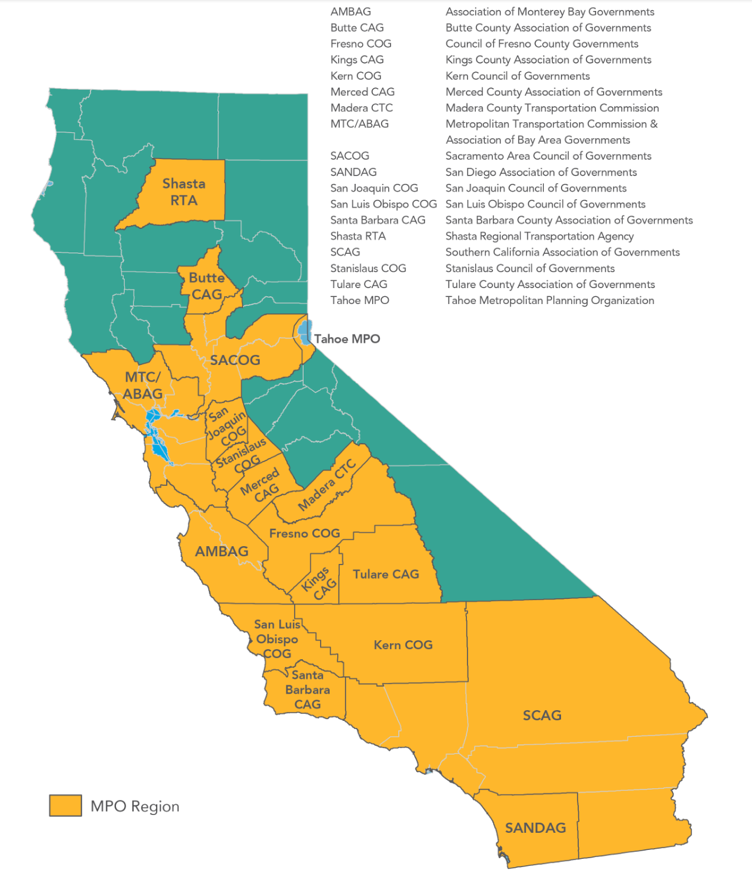
Photo Credit
California Jobs First Council: Coordination Without Integration
The three programs described above mostly funded regional civic and governmental infrastructure and local implementation. The other component of a true state to regional partnership is, of course, the state itself. As explained earlier, the original CERF was set up as a partnership between three state entities, GO-Biz, the Labor and Workforce Development Agency and OPR (later renamed the Governor’s Office of Land Use and Climate Innovation or LCI).
Starting in 2024, the Governor created a new ad hoc California Jobs First Council. This Council – co-chaired by the GO-Biz Director and the Labor Secretary – brings together leaders of the following agencies: LCI, Natural Resources, Food and Agriculture, Environmental Protection Agency, Health & Human Services Agency, Veterans Affairs, and the Public Utilities Commission.
Based on its announcement, the Council would perform the distinct role of interagency coordination and forging a closer connection between economic development and workforce. Specifically, this Council would not only “coordinate the development of a statewide industrial strategy” but also become “an integral component of California’s broader strategy to prepare students and workers for high-paying careers.” In other words, the Jobs First Council would be the interagency coordinating entity focused on business expansion, attraction, and retention and would “work alongside the Council for Career Education” which is charged with creating the Master Plan for Career Education. The statewide Jobs First Council would also support regional “Jobs First Collaboratives” as they sought to “expand industry and create jobs locally.”
The new Jobs First Council though left unclear its relationship with an existing interagency body whose members include many of the same agencies: the Strategic Growth Council (SGC). SGC was created in September 2008 (SB 732) and is housed within LCI, whose director chairs the Council; its state agency members include CalSTA, CNRA, CDFA, EPA, HHS, BCSH.
The stated purpose of SGC is to coordinate the activities of state agencies on a range of issues, many of which are directly connected to economic development, including: protecting agriculture lands, strengthening the economy, revitalizing community and urban centers, and assisting in the planning of sustainable communities. The other core issues of SGC are also directly supportive of economic development, including increasing availability of affordable housing, encouraging greater infill and compact development, advancing climate adaptation, promoting public health, increasing transportation, and promoting water conservation.
In short, the creation of the Jobs First Council draws attention to why SGC had not been used as the body for a more focused interagency coordination around jobs and economic growth. In fact, the idea of adding seats for GO-Biz and Labor to SGC had been discussed during 2019 and 2020 in the initial launch of Regions Rise Together. But over several years (even preceding 2019) SGC became increasingly directed by the Legislature to house additional grant programs and shifted to become more of a granting agency and less of a policy coordinating body. The question of the future of SGC as a coordinating body reemerged in 2026 in discussions at the State’s Sustainable Communities Task Force and among various stakeholders looking into the future of SB 375 implementation and where to house regional investment programs like REAP 2.0.
The creation of the Jobs First Council with GO-Biz and Labor as the two lead agencies reflected the Administration’s shift towards both economic growth as an all-of-government activity, as well as a further emphasis on the need for coordination, something that has long been missing in California’s state government. The tie into the regional investments also sets up the Jobs First Council to be a place of true state to regional partnership and coordination.
But unlike SGC, the Jobs First Council was established by an Executive Order, not established via statute and therefore does not necessarily continue into a new administration. It also does not have the same level of public transparency (e.g. public meetings, public agendas, and/or include legislatively appointed or at-large members)In addition, while the Council coordinates around the Jobs First activities, the formal responsibilities of the Council do not extend to other regional programs such as REAP 2.0 or the K-16 Collaboratives.
Given SGC’s narrowed focus on specific grant programs, and the Jobs First Council’s narrowed focus on the state’s role in a small set of investments, California still lacks an enduring and comprehensive structure for aligning interrelated state programs and regional investments towards an inclusive and sustainable economy—the very coordination challenge that Regions Rise Together sought to address. The opportunity though exists for the Legislature and Governor to consider how to adapt the current interagency councils – whether Jobs First Council or Strategic Growth Council – to be a durable place for a true state and regional partnership.
Conclusion: Lessons from California’s Regional Experiment
Between 2019 and 2026, California conducted its most ambitious regional experiment in history. The $1.45 billion in funding commitments across Jobs First, REAP 2.0, and the K-16 Collaboratives tested whether the state could build a durable regions-up framework.
This investment in regional planning and implementation continues to be one of the core through lines of the Newsom Administration. In a December 2025 interview with New York Times editorial writer and podcaster Ezra Klein, the Governor spoke about the importance of the 13 regional economic development and workforce plans saying “We called it Regions Rising Together. It’s not one economy. It’s the intersection of many different economies.”
The three core regional programs discussed in this paper tested numerous related principles. These included the following:
- Effective plans are produced from an inclusive multi-sector table that breaks down traditional silos between policy areas,
- Every region should be guaranteed funding for core activities (e.g. block grants),
- Funds for regions should support both producing strategic plans and to implement them,
- Competitive pots of funding are good to also include for projects of statewide importance and to encourage regions to prioritize as well as elevate most strategic projects,
- Effective delivery requires not only alignment of policy goals and action across state agencies and systems but also across plans and institutions within regions,
- The state and its regions can be partners in the implementation of key long-term statewide goals, especially around climate resilience, carbon neutrality, energy transition, equity, and economic mobility.
While some of the above principles evolved, they remain core to consider for any future iteration and investment in regional program funding:
The programs were imperfect, but they demonstrated something essential: regions can effectively come together to identify priorities and coordinate across institutions and sectors when given authority and resources. They also demonstrated that regions need to be key dependable long-term partners to the state, both in funding and in alignment of the state’s own policy priorities. Regions-up does not mean region-alone.
Returning to the four lessons identified at the outset, what did we learn?
1. Preparing for Transitions Requires Long-Term Commitment
The programs demonstrate that regions can plan for long-term economic transitions and climate resilience when given resources and structure. However, CERF’s evolution from climate-focused economic transition to Jobs First’s sector-based job creation reveals ongoing tension between transition planning and immediate political demands. The $150 million budget cut to Jobs First also shows how economic development programs without durable institutional homes remain vulnerable.
REAP 2.0 endured a relatively smaller $40 million cut in the 2024 budget (after initial proposals to cut the program by $300 million). This relative budget stability in the end compared to Jobs First suggests that programs anchored in existing statutory frameworks (like SB 375’s Sustainable Communities Strategies) prove more resilient. Still, leveraging the existing SB 375 structure also limits applicability: REAP 2.0’s MPO-based geography doesn’t cover all regions, leaving rural areas without a regional planning framework and dependent on separate funding mechanisms from the state for achieving the same land use and transportation goals.
2. Regions Work When Empowered, But Require State Alignment
Jobs First and K-16 aligned around 13 economic regions, while REAP 2.0 used MPO boundaries. This partial alignment represented progress but fell short of full integration. Regions proved capable of convening diverse stakeholders and identifying priorities (Fresno DRIVE and other regional collaboratives demonstrated this). But state agencies still operate largely in silos with inconsistent and at times contradictory policy priorities.
The Jobs First Council coordinates some agencies but doesn’t extend to all regional programs. It is also not permanent in statute. The Strategic Growth Council offers promise and has taken on more work in regional planning but does not include GO-Biz or the Labor Agency. California still lacks comprehensive ongoing infrastructure for aligning regional investments across economic development, education, housing, transportation, and climate. This is the integrated planning that a true regions-up approach requires.
3. Institutional Durability Requires More Than Good Programs
California now has newly built civic capacity, including Jobs First regional tables, K-16 collaboratives, and strengthened MPO roles. But without ongoing funding commitments, these structures remain fragile. CERF/Jobs First received one-time planning funding and initial plan implementation funding without a clear renewal mechanism. K-16’s future depends on continued state commitment. Only REAP 2.0, tied to existing MPO structures and SB 375 mandates, has some institutional foundation.
At the regional level, the question of which entities should hold authority remains unresolved. Jobs First empowered new multi-stakeholder tables, while leaving traditional players wondering why they should join. For some regions this was an opportunity to leverage and strengthen existing regional civic capacity. Others are looking for how to retain these new tables, with still others trying to build a new enduring civic group based on the lessons learned from California Jobs First. Meanwhile, local governments and employers were not evenly engaged throughout the various regions. REAP 2.0 worked through MPOs. K-16 required partnerships across education systems. Each model has merit, but a lack of clarity about long-term regional governance, the role of employers, and how the various efforts will further coordinate in the future needs resolution.
4. Implementation Funding Is Essential, But So Is Flexibility
The shift from planning or implementation programs to a planning-plus-implementation model marked real progress.[28] Also important is the recognition that pre-development grants helped low-resource areas put together their own high-priority projects, as well as resulting in better projects among all the regions. Jobs First’s competitive implementation grants encouraged regions to prioritize. REAP 2.0’s guaranteed allocations gave MPOs predictable resources. K-16’s requirement for multi-institutional partnerships forced alignment.
However, the tension between state accountability and regional autonomy played out differently across programs. Jobs First’s equal allocation to all regions ($5M each for planning and $14 million each for pre-development) prioritized regional equity over per capita distribution, which upset larger urban regions. REAP 2.0’s population-based formula advantaged growing regions, but didn’t recognize the foundational needs of small population rural areas. Both approaches have merit, but suggest the need for more consistent principles in the future.
The shift of REAP 2.0 from broad VMT reduction to more housing-focused implementation (driven by its placement at HCD) also shows how administrative decisions can reshape program intent. This wasn’t necessarily wrong, but it highlighted the gap between initial vision and implementation reality.
What Comes Next?
California has made substantial investments in elevating the regional scale as a locus for both planning and investment. The civic infrastructure now exists in ways it did not in 2019: regional tables convene stakeholders through cross-sector collaboratives in every region. California now has new regional geographies partially aligned across economic development, workforce, planning, and education. Plans are written and some implementation is underway. But the programs that built this infrastructure were one-time investments, and as of 2026 most of that funding is ending.
Regions Rise Together and subsequent program investments demonstrated that an inclusive, bottom-up regional strategy is feasible at scale. It also exposed unresolved questions about governance, durability, and cross-program alignment that cannot be answered by another round of one-time programs.
But effective durability and long-term sustainability require three elements California hasn’t yet secured:
1. Build Durable Regional Infrastructure and Governance Systems: The most urgent need is to go beyond temporary initiatives and funding cycles to institutionalize the regional infrastructure that Jobs First and K-16 began to build.
2. Secure Consistent Funding and New Implementation Tools: Across all stakeholder discussions, participants named this as the most essential element — and the most absent. The three programs documented in this paper were one-time investments. There is currently no ongoing, dedicated funding stream for regional economic development implementation in California.
3. Institutionalize Region-to-State Communication and Clear State-Level Economic Development Governance: A durable regions-up system requires the state to be a consistent and visible partner, not just a source of funds or compliance requirements. Currently, economic development programs are spread across multiple agencies while land use and transportation are overseen by several agencies. Regional leaders must navigate overlapping processes to access state resources, and the interagency coordination structures that exist are not rooted in statute.
REAP 2.0 was borne out of conversations at the State/MPO workgroup led by the Strategic Growth Council. Jobs First gave regions new opportunities to communicate directly with state leadership. But those channels were program-specific and informal. What is needed is a standing, transparent mechanism for regional voices to reach state policymakers on an ongoing basis, one that persists across administrations and budget cycles.
The Opportunity
Without durable funding and statutory frameworks, the system California has built remains vulnerable to the same cycle of fits and starts that has defined the state’s history of regionalism. The civic infrastructure exists. The proof of concept exists. Without clear roles for both the state and regions, the system risks alienating some who will push back on state actions using the true – but not always helpful refrain “one size does not fit all.”
What California has not yet built is the institutional architecture to sustain it: the statutory authority, the consistent funding, the clear roles at both the state and regional levels. This is not a new problem. It is the same problem California has faced at every prior moment of regional ambition. What is newer now is that California has proof that it can work. We also have something to build on. The question now is whether its leaders will choose to build. This is the opportunity.
This paper is part of CA FWD’s broader regions-up initiative, which seeks to build more durable structures for state-regional partnership, coordination, and long-term investment in California’s regions.
___________
Footnotes:
[1] “Note: This paper is written from the perspective of someone who spent most of the first term of the Newsom Administration at the Governor’s Office of Planning and Research (OPR). Given the interagency and team nature of the work, ‘our’ will typically be used throughout the paper to describe the collective nature of the activity. However, the views and perspectives expressed are wholly those of the author and do not necessarily reflect those of the Administration or the other members of the teams across the various agencies and programs referenced.
[2] See review of SACOG’s visionary role here: https://www.nrdc.org/sites/default/files/implementation-report.pdf
[3] The issue of institutional stall reflects how hard it has been historically to move many big regionalism ideas from theory to practice to long-term effective implementation. According to Mike Teitz, Professor Emeritus from UC Berkeley “The definition of a regionalist is a person who, with all his cohort, links arms—every twenty years in the Bay Area—puts the head down; runs against a brick wall; collapses, bleeding; gets up and says, “Well, maybe better luck next time.” https://www.spur.org/news/2026-01-06/remembering-mike-teitz and https://digicoll.lib.berkeley.edu/record/219116?ln=en&v=pdf
[4] These investments included the following: $600 million in REAP 2, $600 million (initially budgeted) in CERF), and $250 million in K-16. CERF was subsequently cut by $150 million to $450 million, cuts that were not restored.
[5] As Kate Gordon and Lenny Mendonca argued in an op-ed in 2025, “In 2019, a core reality was rising inequality, especially between inland and coastal California. In 2020, the economic shock from COVID-19 underscored our overdependence on foreign supply chains and imported manufactured goods. Today, adding to those challenges is the reality of increasingly frequent and severe climate shocks that threaten our homes and businesses — wildfires, extreme heat, flooding and related increases in electricity and insurance prices.”
[6] Note that REAP 2.0 and CERF/Jobs First both included statewide competitive grants, though there is some disagreement with the extent to which the applications for funding as well as the selected projects aligned with the top regional priorities.
[7] In 2018 during his campaign: https://voiceofoc.org/2018/10/newsom-and-garcetti-campaign-for-orange-county-democratic-congressional-hopefuls/ In 2025 in an interview with Ezra Klein: https://www.nytimes.com/video/opinion/100000010559545/the-contradictions-of-gavin-newsom.html
[9] This phenomenon is comparable to the national frame of “flyover states” which reinforces the east and west coastal bias of political, economic, and media elite.
[10] The idea that the state needs to do better at supporting growing California companies from locating manufacturing within the was discussed during a February 2026 hearing at a state senate select committee on industrial policy. The full committee title is the Select Committee on Economic Development and Technological Innovation, and the Informational Hearing was “Examining California Industrial Policy: Manufacturing and Economic Development.”
[11] See: https://innovation.luskin.ucla.edu/wp-content/uploads/2020/04/Transform_Fresno.pdf for background on the investment by SGC in Fresno.
[12] See: https://lao.ca.gov/BallotAnalysis/Proposition?number=4&year=2024
[13] The task force’s final report noted that to achieve economic recovery: “A key opportunity will be to leverage the work of Regions Rise Together, the State’s initiative to develop cross-sector civic partnerships at the regional level. This initiative has highlighted key economic opportunities in all regions, especially California’s inland counties, and has worked to ensure that inland California has a seat the table. Regions Rise Together has also supported a “regions up” approach to planning and policy, especially “high road” economic development that emphasizes job quality and economic diversification.”
[14] Regions Rise Together was also picked up as a name in several local initiatives (Regions Rise Together in Salinas, funded by Irvine, Redwood Regions Rise in the Redwood Coast).
[15] The program was intended to be administered by the Governor’s Office of Planning and Research (OPR). The Assembly analysis of the bill described it as a “competitive grant program to support regional collaboration among public and private sector stakeholders to address and resolve significant community development issues which currently impede inclusive economic growth and upward mobility for historically marginalized groups.”
[16] The idea of $5 million in funding for each region regardless of population size was not universally popular, and received strong pushback from larger urban regions, most notably Los Angeles County with its 10 million residents. But it was an important signal that regions with historically less investment in economic planning, as well as those resource-dependent regions most affected by economic and energy transition, needed significant support from the program.
[17] It is important to note that while business and local government were listed in statute, few entities participated.
[18] To analyze this proliferation of different regions we subsequently put together a small side project with the Research Bureau of the California State Library to map the different regional definitions. See: https://public.tableau.com/app/profile/california.research.bureau/viz/OPREconomicRegions/BasicMap
[19] For the purposes of CERF, we knew we would establish a greater number of economic regions. The question was: what would be the regional boundaries and how would they vary from the LMID Economic Markets.
[20] It is important to note that county boundaries were largely determined in the 19th century. Some counties straddle multiple economic regions with distinct sectoral bases. Yet we typically use counties as the basic geographic unit for setting up regional planning districts. This does create some ongoing challenges and tradeoffs.
[21] Southeastern California argued for a regional identity encompassing the Coachella Valley, the Palos Verde Valley, and Imperial County. This designation would have aligned with the 2022 recommendations from the Governor’s Blue Ribbon Commission on Lithium Extraction in California, which called for the recognition of a Salton Sea Region as a tool for enhancing economic development activity in this historically disinvested area. Related legislation was introduced in 2023, 2024, and 2025.
[22] See: AB 132, the Higher Education Budget Trailer Bill
[23] Some of these programs include: the Strong Workforce Program (Ongoing; CCCCO), the Golden State Pathways Program (2024-2028; CDE), Learning Aligned Employment Program (2022-2024; CSAC), Cash for College (ongoing; CSAC), Career Technical Education Incentive Grant (Ongoing; CDE), Dual Enrollment (Ongoing; CCCCO), Transfer Program (Ongoing; CCCCO/CSU+UC).
[24] The program was initially approved at $600 million but was subsequently cut by $60 million.
[25] See: https://www.hcd.ca.gov/funding/archive/reap2019
[26] Note that the legislation was ultimately vetoed. Importantly, the bill also tried to align the State transportation plan (CTP) with SCSs, which was a specific attempt to link state goals and priorities with regional plans. Since the legislation did not advance, the state transportation plan remains a vision document that is neither financially constrained nor aligned with regional plans.
[27] There is a lot written elsewhere on the challenges of implementing Sustainable Communities Strategies as part of Regional Transportation Plans, which Metropolitan Planning Organizations have been required to produce since SB 375 in 2008. These “SCSs” had to meet specific per capita greenhouse gas reduction targets. Over the years the plans have increasingly been critiqued as exercises in modeling to meet the targets with less focus on implementation Some regions, especially Sacramento, formalized an agreement with the State that they could not meet the target without direct investment in infrastructure to support the land use vision in their plan.
[28] Note that in the climate resilience world, there had long been the issue of implementation focused programs with no funding dollars. This was one of the main negotiation points in building the 2020 climate budget: how to do both planning and implementation so that they are connected.